


Secretary Marco Rubio delivers remarks from the Acropolis in Athens, Greece, October 7, 2026. Photo: U.S. Department of State / Flickr
Welcome back to Plato’s Workout newsletter: the weekly meditation on the philosophy of human excellence. My mission is to recover the lessons of virtue from the Western Tradition, one Great book at a time. We’ve had 103 recent subscribers eager to Read deeply, Train wisely and Live virtuously. If someone forwarded this to you, subscribe here.
Rubio’s speech: Articulating the essential traits that define the West
On 7 Oct 2026 the US Secretary of State Marco Rubio gave a speech in Athens in front of the Acropolis. His message was that the West can revive itself - both the US and Europe - by recalling its historic ambitions and virtues.
Secretary Rubio said that the West is at a ‘’crossroads,’’ and that ‘’the course we take will determine whether the West maintains its place at the head of the world, or resigned itself to a future of atrophy and servitude and decline. We will either choose to act now, or lose the choice to act at all.”
It was a stark message meant to jolt his fellow European allies, and the US citizens back home.
But more important for our purposes, Rubio did us a service eloquently articulating and highlighting the essential traits that define the West. Here is a summary, in his own words, of what makes the West unique. I have formatted his words for easier consumption:
Here, in Athens, we found the first full realization of all the essential traits that would come to define the West:
fierce individuality and relentless ambition
daring exploration and invention;
a yearning for discovery, for adventure, risk and glory.
an insatiable curiosity about the world and the principles by which it operates,
a hunger to know the mysteries of nature
and grasp the secrets of the cosmos.
an impatience with the notion of impossibility, chafing at all boundaries and limits,
straining to peer into the depths of the unknown.
Where others looked inward, the Greeks were the first to direct their focus outward:
to chase the thrill and glory of seeing all that was strange and new.
it was this trait – it was this trait that would push the West to create and build things that others could not
marking us out from so many other cultures and civilizations where stability and subsistence were the highest ends of life.
But it is not just the ambition to explore the unknown that we inherit from the Greeks; it is the conviction that the unknown can be known:
the confidence that the world can be charted and measured and mapped and understood
and that there is a rational order to the cosmos, governed by certain fundamental laws
laws that men can observe and the mind can come to understand.
The pursuit of excellence: for the Greeks it was the very principle of man’s existence
What was this source of ancient Greek ambition? The Greeks called it arete- excellence and virtue. I wrote how arete was the most articulated value in ancient Greek culture.
Socrates taught the ancient Greeks about excellence and virtue. The Greeks had one word to describe this – arete. For the Greeks arete was a unique word that combined being great (excelling at your field, such as in the military or sports) and being good (being virtuous and caring for your soul).
Rubio explained the importance of the Greek pursuit of excellence and how it was the principle of man’s existence:
For the Greeks of antiquity, the pursuit of excellence was the very principle of man’s existence.
They organized all of civic life around contest, ambition, competition: in philosophy and poetry, in sculpture and drama, in athletics and art, in war and statecraft.
the classical Greek city was an arena for great men to test and prove themselves, to hone their potential through perpetual struggle –
to be the best, the strongest, the most beautiful, straining to inch ever closer to perfection.
Now I know that to modern ears, what I just described, this way of life, may sound odd; it may even sound cruel.
The ideal of many ideologies in our time has, frankly, become a world of perfect safety, devoid of risk or failure, with neither the glory of victory nor the shame of defeat.
Too often these days, we build downwards. We design our standards to ensure no one will lose; we preoccupy ourselves more with the comfort of the worst than the potential of the best.
We hold the most exceptional things among us hostage to the average, the ordinary, the mediocre.
The men who made the Parthenon, they built upwards.
They held that the highest and most noble aspiration in life was to surpass all others, to strive to be the best in all things.
The ancient Greek city-states were filled with intense passion and rivalry and faction and conflict.
But from that constant struggle for distinction – from that came the great flowering of art and philosophy and political and intellectual energy that would transform a collective of Mediterranean cities into the birthplace of the greatest civilization in the world.
“To know them is to know ourselves:” The reading list to understand the Ancient Greeks and ourselves
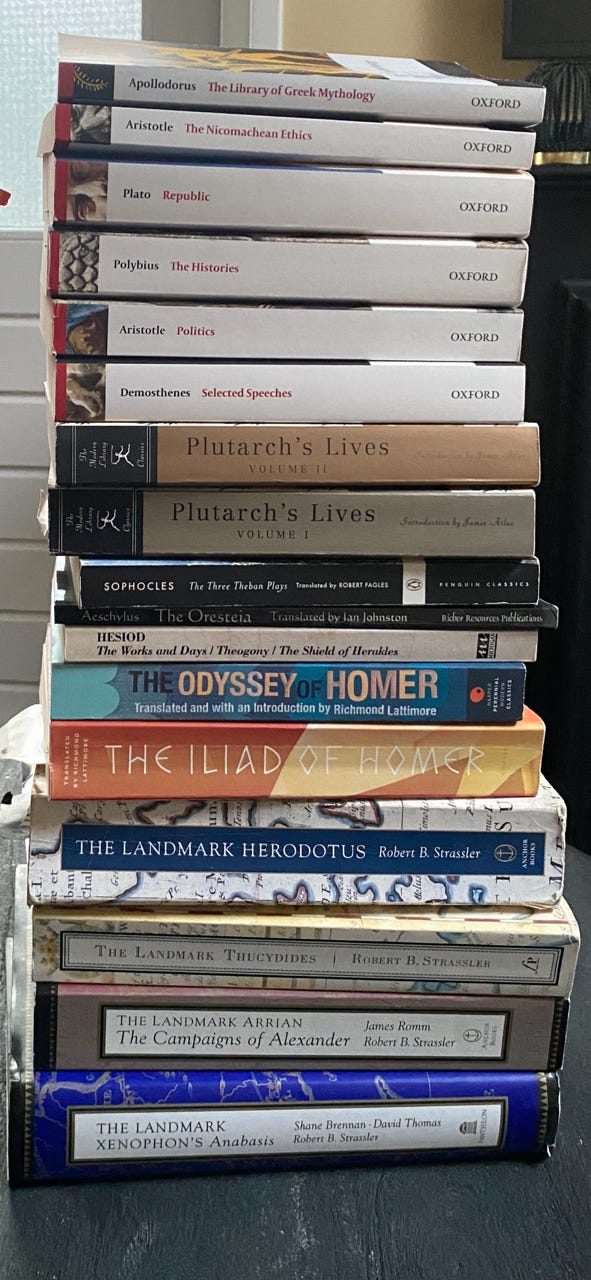
Rubio observed that, “Today, too much of the West has forgotten this quality [of excellence].’’
How do we begin to regain this quality?
Rubio states that ‘’to know them [ancient Greeks] is to know ourselves.’’ He accurately observes these qualities demanded of their citizens were expressed in their ‘’traditions, stories and imagination.’’
These were not just the formulas or precepts of a particular school of philosophy. They were the characteristics of a people – expressed in their traditions, their stories, their imagination; in the qualities they demanded of their citizens; in the things they lived and fought and died for.
Today we also can tap into the characteristics of these people by reading the poetry, philosophy and history that inspired the Greeks to strive for excellence and distinction.
I have written about the importance of creating a lifelong reading list of the 300 Great Books of the Western Tradition.
But to effectively tap into the ancient Greek spirit of excellence you only need to read a fraction of that list.
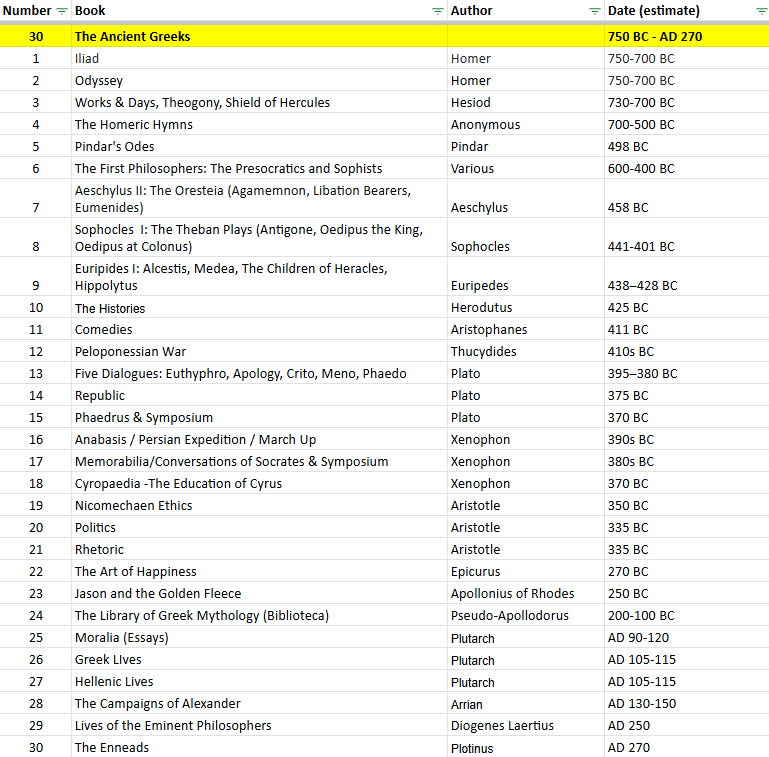
Written over a 1,000 year period, from Homer to Plotinus, here are the 30 books to help us understand the traits of human excellence that have inspired and shaped the West.
What these books can teach us about excellence
What does this Greek spirit of excellence look like on the page? And how can we bring it into our own lives?
These books do not give us one simple formula. The Greeks argued about excellence. They celebrated ambition, but also exposed its dangers. They admired strength, but asked whether a strong man could govern himself. They pursued knowledge, but challenged those who thought they already possessed it.
That is what makes these books such valuable training partners.
Here are some of the lessons waiting for us.
Homer’s Iliad: Strive for greatness—but examine what makes greatness good.
In one of the earliest surviving works of Greek literature, Achilles, Hector and their fellow warriors struggle for honor and distinction. Here we encounter the heroic demand to excel, to prove worthy of those who came before us. But Homer also shows us the terrible cost of anger and wounded pride. Achilles’ meeting with Priam brings something beyond battlefield prowess into view: the ability to recognize another man’s suffering. The question is not simply whether we can become formidable. It is whether we can become formidable without losing our humanity.
Homer’s Odyssey: Endurance and self-command belong beside daring and adventure.
Odysseus ventures into strange lands and confronts dangers that test his ingenuity and courage. Yet his journey is not an endless pursuit of adventre. He is trying to return home. His adventures repeatedly test whether he and his companions can resist temptation, exercise restraint and remember their purpose. For us, the lesson is practical: ambition needs a destination. What are we striving toward, and what temptations keep carrying us off course?
Hesiod’s Works and Days and Pindar’s Odes: Excellence belongs in both the field and the arena.
Pindar celebrates the distinction of victorious athletes. Hesiod brings our attention to labor, justice and the demands of earning an honest living. Read together, they broaden our understanding of arete. There is excellence in a public victory, but also in work performed faithfully when no crowd is watching. We should admire the champion without forgetting the daily discipline that makes achievement possible.
The Presocratics: Have the courage to ask what the world is made of.
These early thinkers sought underlying principles in nature: explanations of change, order, matter and the cosmos. Their answers differed, sometimes radically. Their willingness to question and argue is part of their enduring importance. They invite us to move beyond passive acceptance and exercise our reason. Curiosity becomes more than an appetite for interesting information. It becomes a disciplined effort to understand.
The Greek tragedies: Ambition needs judgment, and conviction needs humility.
In Aeschylus’ Oresteia, the cycle of vengeance gives way to a civic trial. In Sophocles’ Antigone, political authority collides with family duty and divine obligation. In Euripides’ Medea, wounded pride and passion become destructive. These are not comfortable lessons. They force us to confront competing duties, disastrous choices and the limits of our own judgment. The Greeks who celebrated human greatness also understood how greatness could go wrong. Excellence requires more than intensity. It requires learning what deserves our intensity.
Thucydides’ Peloponnesian War: Distinguish boldness from recklessness.
The history of Athens and Sparta gives us courage, endurance and extraordinary political energy. It also gives us faction, brutality and the disastrous Athenian expedition to Sicily. Here is a demanding workout for anyone who leads: learn to examine consequences before enthusiasm makes them invisible. Ambition can build a great city. Ambition detached from sound judgment can help destroy it.
Xenophon’s Anabasis: When circumstances collapse, character must hold.
After the death of Cyrus and the seizure of their generals, the Greek soldiers must find a way home through hostile territory. Courage alone is not enough. They need deliberation, discipline, cooperation and leaders willing to accept responsibility. This is excellence under pressure—not as an abstract ideal, but as a succession of difficult decisions. When the plan fails, can we still be useful? Can we steady ourselves enough to help others move forward?
Plato’s dialogues: The hardest opponent may be your own unexamined life.
Socrates redirects ambition toward the condition of the soul. What good is reputation if we cannot explain what justice is? What good is success if we have neglected the person we are becoming? In the Republic, the education of body and soul belongs within a larger inquiry into justice and the good life. The challenge is not to abandon achievement. It is to stop confusing achievement with goodness. We need to train our desires and judgment, not merely our abilities.
Aristotle’s Nicomachean Ethics: Turn your ideals into habits.
Aristotle brings excellence into the repeated choices of daily life. We develop character through what we do, while practical wisdom helps us judge what a situation requires. Knowing the definition of courage does not make us courageous. Admiring generosity does not make us generous. This should sound familiar to anyone who trains: understanding the exercise is not the same as performing it. Virtue requires practice.
Plutarch’s Lives and Arrian’s Campaigns of Alexander: Study achievement without becoming blind to character.
Great lives give ambition a human face. They allow us to examine leadership, courage and the use of power alongside anger, vanity and excess. Alexander’s achievements stretch our sense of what human determination can accomplish. His conduct also gives us reasons to question whether conquest and self-mastery advance together. We should read these lives neither to worship their subjects nor simply to condemn them, but to sharpen our judgment about what deserves imitation.
Epicurus and Plotinus: Ask whether more is always better.
These thinkers complicate any account of Greek excellence as an endless contest for outward distinction. Epicurus directs attention toward prudent desires, friendship and freedom from disturbance. Plotinus turns toward the purification of the soul and its ascent toward the Good. Their philosophies are different, but both challenge us to examine the ends of our striving. Are we becoming better—or merely becoming busier, richer and more admired?
Recover the spirit by practicing it
Taken together, these books offer something more demanding than a celebration of ancient greatness.
They ask us to become worthy students of it.
Homer can awaken our courage. Socrates can question our priorities. Aristotle can examine our habits. Thucydides can challenge our judgment. The tragedians can expose the pride we mistake for strength.
But none of them can do our training for us.
We can admire Achilles and still avoid difficult duties. We can praise Socrates and remain unwilling to question ourselves. We can read Aristotle on virtue without changing a single habit.
The purpose of this reading list is not simply to know more about the Greeks. It is to let their questions work on us—and then to act.
Choose one book. Read it slowly. Keep a notebook beside you. Ask yourself:
What form of excellence does this book reveal?
Where does ambition become a virtue, and where does it become a vice?
What weakness in my own character does it expose?
What will I practice differently because I have read it?
A civilization’s inheritance does not remain alive merely because its books survive. It remains alive when people read them, wrestle with them and carry their best lessons into daily life.
We do not recover excellence simply by remembering that the Greeks pursued it. We recover it by undertaking the pursuit ourselves.
Read deeply. Train wisely. Live virtuously.
This is excellent writing! Thank you for such a deep, thought-provoking post.