

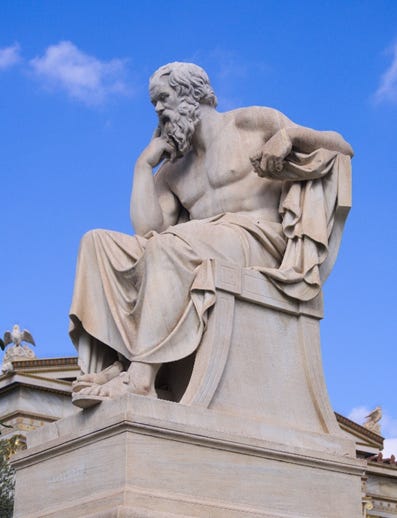
Source: Wikimedia Commons; The Statue of Socrates at the Academy of Athens. Work of Leonidas Drosis (d. 1880)
Socrates taught the ancient Greeks about excellence and virtue. The Greeks had one word to describe this – arete. For the Greeks arete was a unique word that combined being great (excelling at your field, such as in the military or sports) and being good (being virtuous and caring for your soul). Socrates embodied this and can become a role model for us.
Even with a basic knowledge of Socrates, we are not surprised to see him preaching to the ancient Greeks about the importance of being good,
The struggle (agon) to be good rather than bad is important, Glaucon, much more important than people think. Therefore, we mustn’t be tempted by honor, money, rule or even poetry into neglecting justice and the rest of virtue.
– Socrates, Plato’s Republic (10.608b)
and exhorting the importance of caring for one’s soul:
Good Sir, you are an Athenian, a citizen of the greatest city with the greatest reputation for wisdom and power; are you not ashamed of your eagerness to possess as much wealth, reputation and honors as possible, while you do not care for nor give thought to wisdom and truth, or the best possible state of your soul?
- Socrates, Plato’s Apology (29d–e)
Socrates focuses on morality and virtue
Socrates has been called the founding father of Western philosophy. But he wasn’t the first ancient Greek philosopher. What makes Socrates unique is that he was the first Greek philosopher to focus on morality and virtue. Before Socrates philosophers were focused on the natural world. To historically mark this important demarcation philosophers before Socrates have been classified as ‘pre-Socratic.’ This change in focus from the physical to the ethical realm marks a crucial turning point in Western thought.
Socrates’ concentrated on moral questions and the pursuit of virtue. Compared to the pre-Socratic focus on natural science he narrowed his focus on how one should live a good life. This ethical emphasis became a cornerstone of all future Western philosophy.
The Roman statesman and philosopher Cicero summarized Socrates’ impact well when he said Socrates:
“was the first to call philosophy down from the heavens, transfer it to society and even introduce it into people’s homes, and compel it to inquire about life and morality—about what things are good and bad.”
- Cicero, Tusculan Disputations 5.4.10.
Aristotle’s summary of Socrates’s work and impact is also helpful for us.
“Although he confined his inquiry to ethics and did not study the nature of the universe as a whole, he still sought within the moral sphere for the universal and was the first to concentrate his attention on definitions.”
- Aristotle, Metaphysics 987b1–4
So other great historical philosophers, like Cicero and Aristotle, acknowledged Socrates' immense influence on things ‘’good and bad,’’ the ‘’moral sphere’’ and ‘’ethics.’’ These are the domains of virtue.
But virtue has an expansive history in the ancient Greek world. It’s important to understand what virtue meant in Greek society before, during and after Socrates' life. This wider view and understanding of virtue will help us to better understand why the original meaning is a crucial concept for our personal growth.
The most articulated value in ancient Greek culture
The ancient Greek word arete is the best expression of achieving the highest form of excellence and reaching your highest potential.
Arete is a complex word that has deep meaning in the world of ancient Greece. It’s been translated as excellence, virtue, valor, skill, goodness and nobility. It was a central concept for warriors and athletes and equally used by philosophers and poets. It was used to describe the warrior-heroes of Homer and the athlete-heroes of the ancient Olympics. At the same time, it was an integral part of the philosophy of Plato and Aristotle.
Arete’s history sheds light on why this multifaceted word is an ideal concept to embrace for our personal performance. Arete has been called ‘’the most articulated value in Greek culture.” 1 With that kind of cultural impact, we want to have a better understanding of this word and concept.
There is no real understanding of the epics of Homer, the original athletic contests (Olympic games) or the philosophy of Plato and Aristotle, without an understanding of arete.
Our cultivation of arete has to start with Homer. Arete shares the same root as the word ‘’aristeia” – where we get our word aristocracy. In Homer’s Iliad, aristeia meant ’‘being the best and outperforming others.” German classicist Werner Jaeger explains that arete was the “quintessence of early aristocratic education. A noble's arete in Homer, is specifically indicated by his skill and prowess as a soldier in war, and as an athlete in peace” 2
The military leaders fighting near the walls of Troy, Achilles being the most famous, were expected to show superior ability and nobility.
And Peleus the aged was telling his own son, Achilles
to be always best in battle and pre-eminent beyond all others.
– The Iliad, 11.784 (Lattimore translation)
For Homer, arete primarily meant the skill, strength and other virtues of a warrior. Another character of the Iliad was Glaukos. This warrior, who had a smaller part, was a leader in the Lycian army, an ally of the Trojans. He tells us of his father’s instructions when he sent him to Troy:
he sent me to Troy, and urged upon me repeated injunctions,
to be always among the bravest, and hold my head above others.
- The Iliad, 6.207 (Lattimore translation)
Here is how Stephen Miller, the late professor of Greek archaeology and athletics, describes arete:
The Greek word arete comes down to us inextricably connected to the athletics of ancient Greece and laden with a plethora of meanings. A definition of arete would include virtue, skill, prowess, pride, excellence, valor, and nobility, but these words, whether taken individually or collectively, do not fulfill the meaning of arete. Arete existed, to some degree, in every ancient Greek and was, at the same time, a goal to be sought and reached for by every Greek. 3
Excellence of mind and body
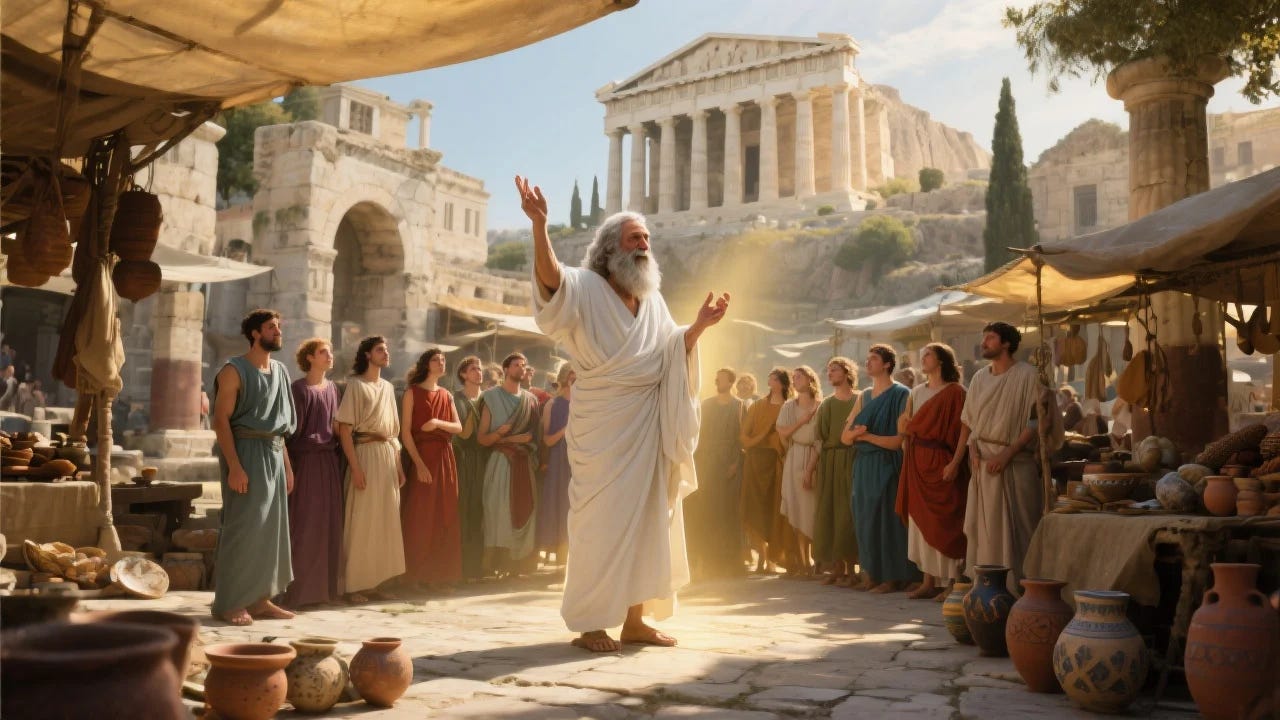
As Stephen Miller mentions above, and dedicates an entire book to, arete is “inextricably connected to the athletics of ancient Greece.’’ In drama, sculpture and poetry, the victorious athlete has a prominent place in ancient Greek culture and society. The lyric poet Pindar of Thebes (518-438 BC) specialized in praising the performances of victorious athletes. He wrote victory odes (epinikion, literally ‘’on victory’’) which were usually commissioned by the athletes themselves or by someone on their behalf. These odes attested to the excellence of the athletes:
The race of men is one thing, that of the gods, is another. There is a total difference in power, so that we are nothing- while the bronze heaven remains the gods' secure seat forever. But, nevertheless - we can become something like the gods, through excellence - excellence of mind or of body; even if we don't know from day to day - or night to night- what finish line fate has marked for us to run.'
– Pindar, Nemean 6:1-7 [my emphasis] 4
These ancient Olympic athletes weren’t aristocratic warrior princes, like their predecessors in Homer. They were everyday citizens who achieved their heroic stature through arete in skills like running, wrestling, boxing, discus and javelin. And the prizes they received represented a public recognition of their arete.
One of the best expressions of the arete of these ancient Greek warrior-athletes is an anecdote from the Greco-Persian wars as told in Herodotus’ The Histories. The Persians were questioning some deserters from Arcadia (ancient Greek tribe from Peloponnesus) about the celebration of the Olympic festival. A Persian reacted with amazement and disbelief at the Greeks’ motivation:
for when he heard that their prize was an olive wreath rather than money, he could not bear to keep quiet, but cried out to them all, “Good grief, Mardonios, what kind of men did you lead us here to fight, who compete not for money but for excellence [arete] alone?”
- Herodotus, The Histories, 8.26.3, (Strassler edition)
The second famous ancient Greek historian, Thucydides, also illustrated the importance of arete, this time in a political setting. In his famous work called The History of the Peloponnesian War he told the story of the war between the most powerful Greek city-states, Athens and Sparta (431-404 B.C.)
One of the most famous passages of the book was the so-called Funeral Oration of Pericles, the leader of Athens. “Our forefathers, who have always inhabited this land, by their arete handed it down in liberty from generation to generation.” Danish historian David Gress, author of From Plato to Nato, explains Thucuydides interpretation of arete:
...the essential quality of the free man was arete, that most characteristic and untranslatable of Greek terms, which connoted skill, strength, personal courage, and the pursuit of excellence in all activities. 5
Reaching your highest potential and the pursuit of excellence
This notion of arete as the pursuit of excellence may be most helpful to us modern high performers. Arete has been commonly translated by modern scholars as excellence or virtue but it had a deeper meaning for the ancient Greeks. It was considered something closer to "being the best you can be," or "reaching your highest human potential." 6 It’s more akin to the former US Army recruiting slogan (from 1980 – 2001), when Tom served as an Army officer: Be All You Can Be.
In his lecture “The Pursuit of Arete,’’ Dr David T. Porter explains the integrated training approach to arete as the quest for excellence in mind, body and soul:
Arete, the pursuit of excellence, was a significant part of the paideia, the ancient Greek process of training boys to become men. This training in arete included: physical training, for which the Greeks developed the gymnasion; mental training, which included oratory, rhetoric, and basic sciences; and spiritual training, which included music and what is called virtue. The paideia sought a balance of physical, mental, and spiritual training all pointing toward arete, excellence, becoming your best; reaching your highest human potential. 7
He goes on to explain that arete was not about competition, winning or even a quest for superiority:
It is about intellectual, physical and spiritual excellence. It may be demonstrated in a competition, but it is not about the outcome as much as it is the process. Arete is a matching of practice and potential and should not be limited by the nature of the task. It is the realization of a man's total potential. 8
So why should we care about arete?
Isn’t this just an obscure ancient Greek word?
Just like modern psychologists have discovered that one of the best ways to describe the deep meanings of happiness – flourishing and well-being – is to re-discover Aristotle’s ideas of eudaimonia, we modern high performers need to embrace arete as the best concept of excellence.
Let’s summarize the components of arete:
Both warriors and athletes displayed arete
Both poets (Homer) and philosophers (Socrates, Aristotle and Plato) exhorted arete’s virtues and defined its meaning
Arete means excellence – with skill and virtuosity
Arete also means virtue – character, goodness, valor, nobility
Arete is about the pursuit of excellence, reaching your highest potential; ‘’being all you can be.”
Arete was a significant part of the training and education (paideia) of ancient Greeks. This was a quest for excellence in body, mind and soul.
Is it any wonder arete has been called “the most articulated value in Greek culture,’’ and “ a goal to be sought and reached for by every Greek.’’
In the next lesson we will see how Socrates’ most famous student - Plato - actually created an integrated training program to develop arete.
Notes
Arete, virtue, goodness, excellence https://hathawhag.weebly.com/uploads/6/6/0/3/6603650/r._hooker_re_aret_copy.pdf
Aristocratic Life and Values in Homeric Greece http://www.ancientdigger.com/2011/10/aristocratic-life-and-values-in-homeric.html
Miller, Stephen G.. Arete . University of California Press. Kindle Edition
M. Gregory Kendrick. The Heroic Ideal: Western Archetypes from the Greeks to the Present (Kindle Locations 902-905). Kindle Edition
Gress, David. From Plato to Nato: The Idea of the West and Its Opponents, p. 55, Kindle Edition
Arete, virtue, goodness, excellence https://hathawhag.weebly.com/uploads/6/6/0/3/6603650/r._hooker_re_aret_copy.pdf
The Pursuit of Aretê, Dr. David T. Porter https://speeches.byuh.edu/david-o-mckay-lecture/the-pursuit-of-arete?utm_source=pocket_mylist
The Pursuit of Aretê, Dr. David T. Porter https://speeches.byuh.edu/david-o-mckay-lecture/the-pursuit-of-arete?utm_source=pocket_mylist