

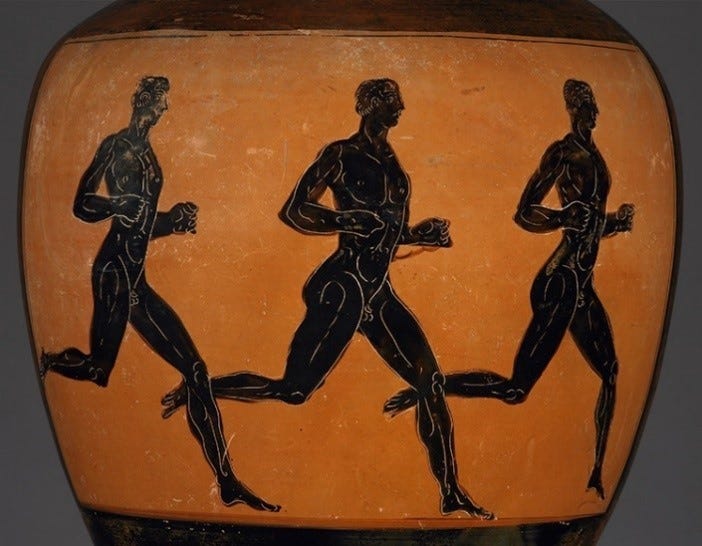
Source: Wikimedia Commons: Body beautiful: Greek amphora, Attica, fourth century BC.
We saw in lesson 2 Socrates preaching to the ancient Greeks about the importance of being good:
‘The struggle (agon) to be good rather than bad is important, Glaucon, much more important than people think. Therefore, we mustn’t be tempted by honor, money, rule or even poetry into neglecting justice and the rest of virtue.’ – Socrates, Plato’s Republic 608b 1
But Socrates taught the Athenians a particular conception of excellence that included a strong body as well as soul:
“Besides, it is a disgrace to grow old through sheer carelessness before seeing what manner of man you may become by developing your bodily strength and beauty to their highest limit. But you cannot see that, if you are careless; for it will not come of its own accord.” – Socrates, Xenophon’s Memorabilia 3.12 (Loeb version)
Why is the founding father of Western philosophy lecturing this youth about the benefits of physical fitness?
This may be strange to our modern sensibilities – an old ‘academic’ philosopher lecturing on physical fitness – but was quite normal in ancient Greece. The Greeks were the first people in western civilization to introduce an integrated program of training the body and mind.
Socrates’ goal was the education of virtue – excellence and morality. Through his famous student Plato we see a specific workout program to develop virtue, what the Greeks called arete. In the classic philosophy book The Republic Plato has the following goal for his leaders, the guardians:
Anyone who is going to be a truly good guardian of our community, then, will have a philosopher’s love of knowledge, and will be passionate, quick on his feet, and strong.
Absolutely, he said. - The Republic, 376c
And our guardians are, in fact, both warriors and philosophers.’
Of course. - The Republic, 525
Exercising gymnastics and music: getting a physical and cultural workout
So, what kind of training produces virtue: excellence and morality?
'Gymnastics" and "Music.''
Plato devotes a considerable amount of content to the education of the guardians, the leaders of his ideal city. He provides a lifelong education program that transforms the guardians into philosopher-kings, with the foundation being the blend of the physical and the cultural. The ancient Greeks used the words gymnastiki and mousiki. These are sometimes translated as ''gymnastics" and ''music'' but that is not quite accurate.
We certainly get the English words ''gymnastics'' from the Greek gymnastiki. But it had a deeper meaning for the ancient Greeks. The term can be thought of as a broad physical training and health program. The 20th Century French professor of classics, H.I. Marrou, who specialized in ancient Greek education, explains the deeper meaning.
‘’To the Greeks, sport was not merely a pleasant form of relaxation; it was a highly serious business, involving a whole complex of affairs concerned with hygiene and medicine, aesthetics and ethics.’’ and “Thus physical training remained an essential part of the process of initiation into civilized life – that is to say, of education…’’ 2
The Greek word for music, mousiki, literally means the ‘art of the muses.’ The muses were the goddesses of “music,” not just in our modern understanding of the word but in a broader cultural conception. They were the inspiration for literature, arts, poetry, lyric songs, drama and myths that were for centuries passed down in ancient Greek culture.
Athlete, gymnasium, Olympics, hero, calisthenics, gymnastics, diet and hygiene are all Greek words.
But so are philosophy, psychology, poetry, tragedy, drama, history, rhetoric and music.
And all of these disciplines and practices – the physical ones (“gymnastics") like exercise, combat sports, diet and health and the intellectual and creative ones (“music”) like philosophy, literature and art – were trained at the same location: the gymnasium.
Staring back from the modern academy to the world of Classical Antiquity, it is easy to forget that the ancient Academy was a gymnasium and that Plato was an athlete—a wrestler serious enough to compete at the Isthmian Games—before he became a philosopher. 3
For us moderns these disciplines are totally separate fields of study and training. Working out at the gym and studying the humanities have no formal connection. For the ancient Greeks they were elements of an integrated approach to being an excellent man in an excellent society; to achieve greatness in word and deed.
‘So in my opinion what we find is that, since we have a dual nature, God gave us two corresponding areas of expertise—culture and physical exercise—for our passionate and our philosophical aspects. He didn’t give them for the mind and the body, except incidentally; the purpose was for those two aspects of our nature to fit harmoniously together by being stretched and relaxed as much as is appropriate.’ The Republic, 411 e
‘Yes, that seems to be so,’ he said. ‘Therefore, it isn’t the person who attunes the strings of a lyre to one another, it’s the person who makes the best blend of physical exercise and culture, and who applies them to the mind in the right proportions, whom we should really describe as a virtuoso and as having the most harmony in his life.’ The Republic, 412a
To Plato (here channeled through Socrates) "God gave us two corresponding areas of expertise—culture and physical exercise—for our passionate and our philosophical aspect." The ''virtuoso" who makes ‘the best blend’’ of this balanced program has ''the most harmony in his life.''
Reorienting the Mind through Dialectic
After ''gymnastics'' and ''music,'' Plato's long educational program progresses to mathematics and culminates in dialectic, philosophic examination – with others and yourself. The competitive skills and spirit cultivated through physical training is now applied to philosophical exercises.
Philosophy professor and ex-athlete Heather L. Reid explains the philosophical method of active inquiry created by Socrates mirrors an athlete's actions. “I actually think Socrates’ Socratic Method (a form of inquiry and discussion between individuals based on asking and answering questions to stimulate critical thinking) is an athletic way of seeking knowledge,'' she says 4
We shouldn't be surprised that Plato embraced the athlete's way of seeking knowledge and wisdom. According to the ancient biographer Diogenes Laertius, in his book The Lives of Eminent Philosophers, Plato is a nickname he received from his wrestling coach meaning ''broad,'' signifying his broad shoulders. In the same passage we are told Plato ''wrestled at the Isthmian games'' (panhellenic athletic competition, similar to the Olympic games), most likely as a boy. 5
Virtue [arete] in Plato's explanation, Heather Reid explains , ''is understood as a kind of health and harmony in the soul, which, like bodily health, requires continual exercise or training (askesis). This exercise can be either physical or intellectual (ideally, it would be both). The issue is not so much the activity as its orientation. It needs to aim at Platonic virtue, which is to say at improvement of the soul, which is to say wisdom, which is to say philosophy." 6
We see Socrates’ lofty goal for training leaders is ''how to lead them up to the light' and the ''re-orientation of the mind'' through ''true philosophy.''
Socrates: ‘So would you like us to consider next how to produce people of this type in our community, and how to lead them up to the light—like the people we hear about who rise from Hades to dwell among the gods?’*
Glaucon (Plato's brother): ‘Yes, of course I’d like us to do that,’ he replied.
Socrates: ‘Now, what we’re dealing with here, it would seem, is not the spinning of a potsherd, [broken piece of pottery] but the reorientation of a mind from a kind of twilight to true daylight—and this reorientation is an ascent to reality, or in other words true philosophy.’ The Republic, 521c
For Socrates the goal of philosophy was not to inform, but form and ultimately transform lives. The ancient Greek philosophers, the students and intellectual offspring of Socrates, weren't concerned with acquisition of abstract knowledge, but transforming one's vision of the world, through the ''reorientation of a mind,'' as Socrates teaches in Plato's Republic.
In the next lesson we will take a deeper look at gymnastiki, the Greek physical program of health and exercise.
Notes
The Republic quotes are from Waterfield, Robin. Republic (Oxford World's Classics) OUP Oxford. Kindle Edition
H.I. Marrou A history of education in antiquity. Translated by George Lamb. Madison, Wisconsin: University of Wisconsin Press.
Reid, Heather; Palumbo, Lidia; Smith, Nicholas; Moore, Christopher; Dova, Stamatia; Evans, Matthew; Kenyon, Erik; Dombrowski, Daniel. Athletics, Gymnastics, and Agon in Plato (p. 9). Parnassos Press - Fonte Aretusa. Kindle Edition.
Morningside prof sees beauty in ancient games reborn https://siouxcityjournal.com/special-section/siouxland_life/morningside-prof-sees-beauty-in-ancient-games-reborn/article_e6dbef57-be55-572d-bafb-41945d9923b6.html
Diogenes Laertius, The Lives of Eminent Philosopher, 3.1.5
Reid, Heather; Palumbo, Lidia; Smith, Nicholas; Moore, Christopher; Dova, Stamatia; Evans, Matthew; Kenyon, Erik; Dombrowski, Daniel. Athletics, Gymnastics, and Agon in Plato (p. 27). Parnassos Press - Fonte Aretusa. Kindle Edition.