

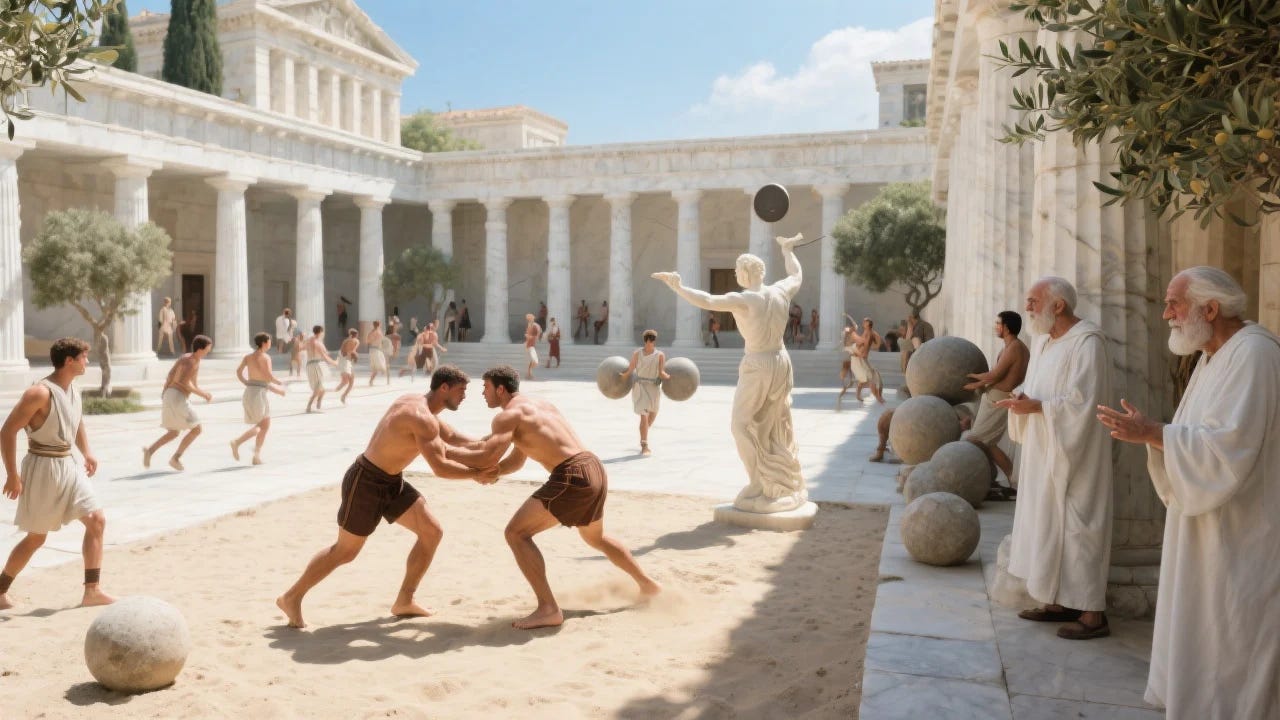
How do we operationalize the wisdom of the ancient Greeks and use it for our own personal growth practice?
We need to remember that Socrates, and the ancient Greeks in general, focused on virtue as the means to flourish. As we’ve seen in lesson 2, the Greeks used the word arete which meant excellence, moral virtue and the goal of life, the highest good.
If we look at the Classical Western Tradition as a whole, we see an integrated approach to virtue and excellence. For the Greeks, virtue was physical and moral/intellectual excellence. The Christians inherited the Hellenic tradition of moral/intellectual excellence, expressed supremely as the cardinal virtues (courage, wisdom, justice and moderation), purified these excellences and added spiritual virtues (known as the theological virtues) of faith, hope and love.
Examining these three types of virtues – physical, moral/intellectual and spiritual – and discovering how they were practiced in Athens and Jerusalem, we can discern the timeless ancient wisdom of human excellence and can begin to apply it to our modern practice for personal growth.
The physical virtues and physical well-being
The gymnasium’s 2,800-year history places it among the oldest human institutions: it predates the foundation of the Christian church by eight centuries and of representative parliamentary democracy by 2,500 years. - Eric Chaline 1
The foundation for Hellenic excellence was physical. We've seen how both Socrates and his student Plato include physical training – gymnastiki – in their leadership training as outlined in The Republic. So it shouldn't surprise us that Plato's famous student, Aristotle, preached the same message. Aristotle was not only a student of Plato’s Academy (a gymnasium) but also mentored the legendary king of Macedonia and arguably the most famous military leader in history, Alexander the Great.
In Aristotle's book The Art of Rhetoric, he shares the elements of happiness:
Let happiness, then, be virtuous welfare, or self-sufficiency in life or the pleasantest secure life or material and physical well-being...also the physical virtues (e.g. health, beauty, strength, size and competitive prowess).'
For a man to would enjoy the greatest self-sufficiency if he possessed both internal and external advantages. The internal advantages are those connected with the soul and those connected to the body. 2
Aristotle goes on to explain that ''the excellence of the body is health, and that in such a way that those using their bodies are free from disease..." He also shares how to achieve strength - ''which must be done by dragging, pushing, lifting, pressing or squeezing,'' and that ''competitive physical prowess is composed of size, strength and speed.'' But he's also wise about the impact of aging on health. "A good old age is a slowness to age and freedom from pain." A good old age ''is a product of both of the excellences of the body and luck.''
Your Civic Duty to Train at the Gym
Socrates, Plato and Aristotle were all members of a Greek society that valued physical excellence. They, and all other elite members of the Greek polis, city-state, were members of gymnasiums. Citizens of the polis’ were expected to go workout. The famous playwrights, poets, politicians and philosophers that created the glory that was ancient Greek culture all were members of a gymnasium.
To say that the city-states of Classical Greece expected everyone within their walls to maintain rigorous levels of physical fitness is an over-simplification. But it is not unrealistic to imagine that many of the ‘big names’ who come to mind from Classical Greek history and culture probably spent some time each day exercising in the precincts of a gymnasium. Sophocles was a successful writer, Pericles a busy politician, and Socrates a committed philosopher – but it is unlikely that any of them neglected his regular workout. 3
Training at the gymnasium was a pre-requisite to be a good citizen. A good citizen was virtuous in body and mind. For the Greeks, training wasn’t a lifestyle choice; it was their civic duty.
The ancient Greeks looked at the gymnasiums very differently than we moderns do. “But perhaps we should begin with an unfamiliar notion. What if gymnasium attendance was deemed one of the normal obligations of citizenship – like paying tax?” asks classicist Nigel Spivey. 4
For us moderns a gym is an optional membership club where we can go to exercise. Only 20% of Americans are members of a gym. And most of those paying members don’t even attend. Research in 2018 showed that “63% of [gym] memberships go completely unused.” 5
Gymnasticus: the only ancient text dedicated to athletics
The Greek sophist Philostratus (AD 170-250) wrote a training manual and athletic history in about AD 220 called Gymnasticus, Latin for gymnastiki, exercise. The book can be translated as On Exercise. His goal was to recapture the art of athletic training and reconnect with the glorious past of the ancient athletes and connect them with the imperial present of the Roman empire.
Gymnasticus is the sole surviving ancient book on training and sports. According to the editors of the Loeb edition of this book, “it reshapes conventional ideas about the athletic body and expertise of the athletic trainer and also explores the history of the Olympic Games and other major Greek athletic festivals.”
This ancient training manual starts with a counter-intuitive point for us modern athletes: training is a form of wisdom comparable to other skills. “Athletic training (gymnastiki)…is a form of wisdom (Sophia) and one which is inferior to none of the other skills (technai).’ (Gymnasticus, p. 335). Philostratus’ training manual includes wisdom on progressive resistance, diet and split training routines.
Here is how Philostratus described the strength training of past Greek athletes:
Some trained themselves by carrying weights that were hard to lift, some by competing for speed with horses and hares, others by straightening or bending thick pieces of wrought iron, while some yoked themselves with powerful, wagon-drawing oxen, and others wrestled. - Gymnasticus, p. 471
The concept of progressive strength and resistance training was known to the ancient Greeks. Notice the reference to ‘weights’ and ‘iron.’ The ancient Greeks were one of the first civilizations to incorporate resistance equipment into their training. “Carrying weights that were hard to lift” included rudimentary equipment made of ‘iron’ and stone. Janice Todd, professor of kinesiology and former record-setting powerlifter, notes the significance of the Greeks’ impact on modern weight training equipment:
Although the ancient Egyptians, the ancient Chinese, the ancient Indians, and many other early peoples practiced resistance exercise, credit has traditionally been given to the ancient Greeks for producing the forerunners of our modern weight training equipment. 6
The People of the Gymnasium
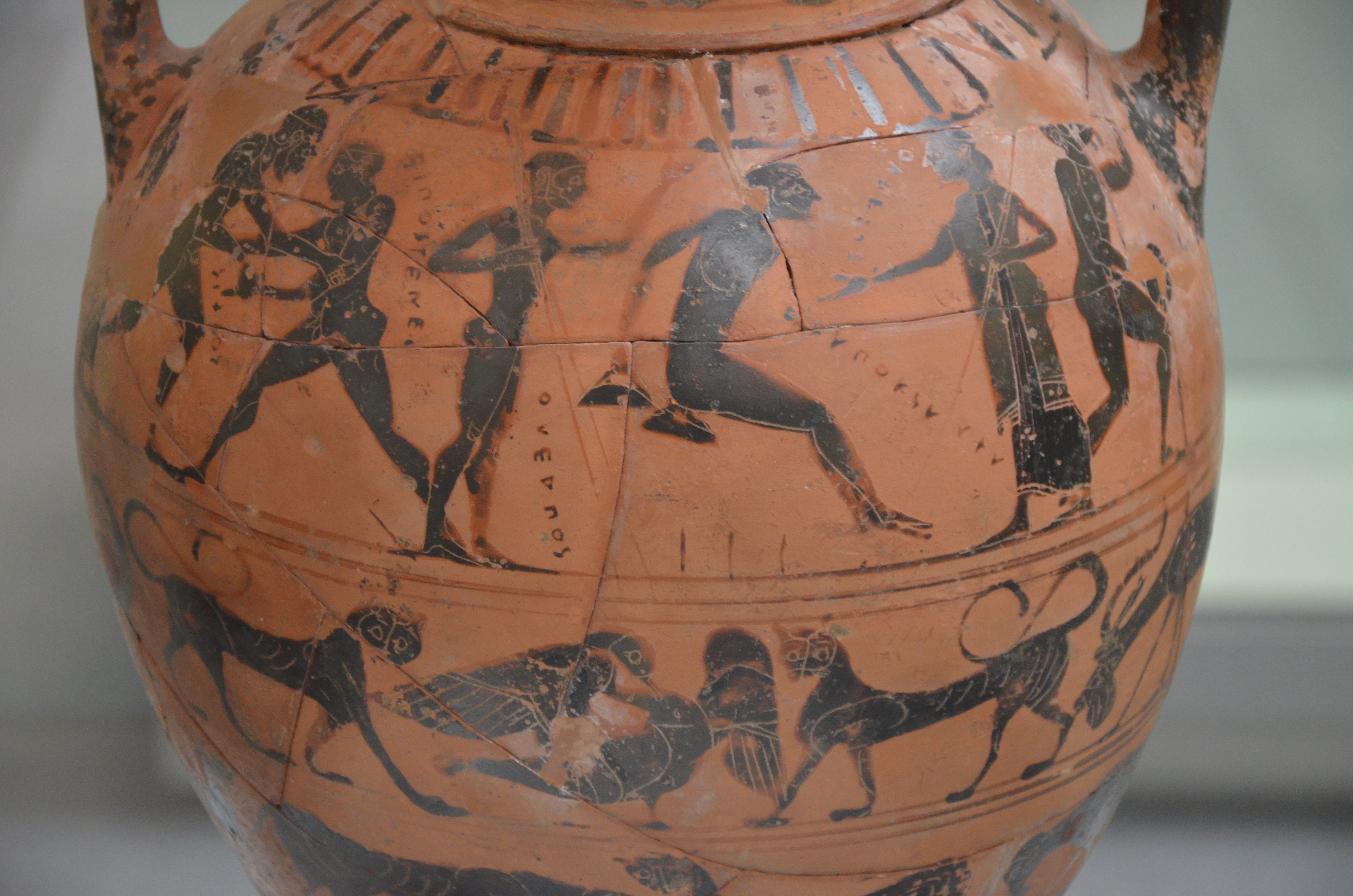
Source: Wikimedia commons. Black figure tyrrhenian amphora in the British Museum, London, depicting athletes competing.
Gymnasiums were an integral part of Greek culture and society. Along with the market-square (agora) and the council-house (bouleutêrion), it was one of the most recognizable features of the city-state (polis). 7
In fact, gymnasia became a fundamental aspect of Greek identity. “Over the course of time, because athletics became so fundamental an aspect of Greek identity, the very presence of a gymnasium would define a city as being Greek or Hellenized,” explains Robin Waterfield. 8 .
The gymnasium is actually one of the first places - physically and culturally - where Athens and Jerusalem first met. The Book of the Maccabees, a series of books contained in various canons (deuterocanonical books) of the Bible, shares the story of the leaders of the Jewish rebellion against the Seleucid Empire. The Maccabees were rebelling against the ruling Seleucid dynasty, which was a Hellenistic kingdom founded by one of the generals of Alexander the Great.
The Maccabees criticized their fellow Jews who wanted to adopt the Greek culture and abandon their faith, symbolized by building a gymnasium: “And they built a place of exercise [gymnasium, in the original Greek] in Jerusalem according to the laws of the Gentile.” (1 Maccabees 1:14). In the neighboring Hellenic kingdom of Ptolemaic Egypt, one of the ways that Greeks were referred to was ‘the people of the gymnasium.’ 9
How do we honor our civic duty and become people of the gymnasium ?
In the next lesson we will take a deeper look at Philosophia – the love of wisdom and channeling the muses.
Notes
Chaline, Eric. Temple of Perfection: A History of the Gym (p. 7). Reaktion Books
Aristotle, The Art of Rhetoric, Chapter 1.5. Happiness
Spivey, Nigel. The Ancient Olympics (pp. 32-33). Oxford University Press. Kindle Edition.
T Spivey, Nigel. The Ancient Olympics (p. 32). Oxford University Press. Kindle Edition).
Are gym memberships worth the money?, The Hustle February 09, 2024 https://thehustle.co/gym-membership-cost
Jan Todd. “From Milo to Milo: A History of Barbells, Dumbells, and Indian Clubs“. Iron Games History 3 (6) 1995: 4-16
Spivey, Nigel. The Ancient Olympics (p. 34). Oxford University Press. Kindle Edition.).
Waterfield, Robin. Olympia (The Landmark Library) (p. 59- 60). Head of Zeus. Kindle Edition.)
Waterfield, Robin. Olympia (The Landmark Library) (p. 59- 60). Head of Zeus. Kindle Edition.).