

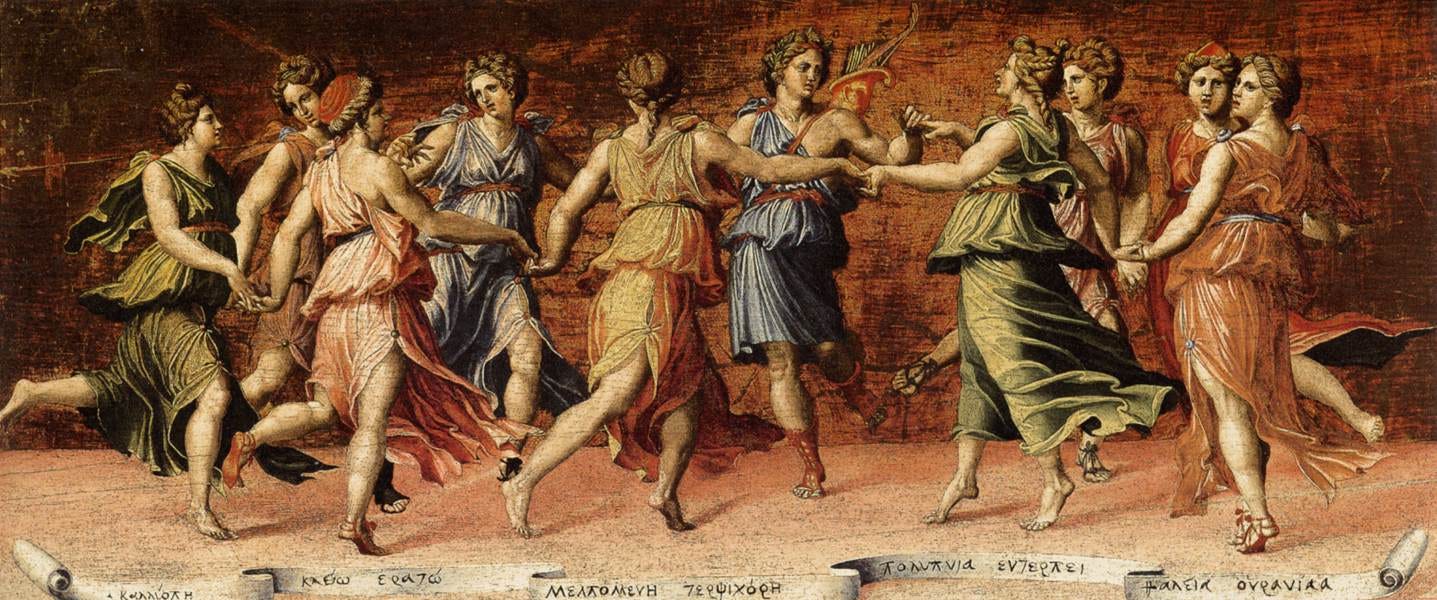
Baldassarre Peruzzi - Apollo and the Muses, Wikimedia

“My father, wishing me to become an accomplished man made me learn the whole of Homer, so that even today I can still recite the Iliad and Odyssey by heart.’’
- Nicoratus, Xenophon’s Symposium
“There are many testimonies to the fact that every cultivated Greek had a copy of Homer’s work at his bedside (as Alexander did during his campaigns)” 1
The next part of the classical Greek program for growth and excellence is mousiki, the art of the muses. Mousiki was the cultural workout that Plato wrote about that included literature, poetry, drama and music. The goal was to cultivate the love of wisdom - philosophia.
From the Noble Warrior to the Scribe
The ancient Greek ideal of human excellence called for lifelong commitment to moral and intellectual education. Classical Greek education has a history, progressing from Homer to the Bible. The 20th century French classist H.I. Marrou explained the development well, summarizing it as a transition ‘’from the noble warrior to the scribe.’’
To sum up this complex development in a simple formula, it might be said that the history of ancient education reflects the progressive transition from a ‘noble warrior’ to a ‘scribe’ culture…. The whole history of ancient education constitutes a slow transition from the latter to the former type of culture. 2
Marrou shares with us the central importance of Homer for Greek education.
It’s origins are to be found in a society still impregnated with the warrior spirit, which nevertheless manage to produce the central pivot around which the whole of Greek education was to be organized – and this was a book, Homer’s Iliad, though it is true that it was entirely devoted to celebrating the deeds of heroes. 3
Plato called Homer the educator of Greece. In The Republic he wrote about ‘’those who praise Homer and say that he’s the poet who educated Greece,’’ (Republic 606e). Greek literary education kept Homer as the basic text from its studies. Homer wasn’t valued so much as a literary text but because the Greeks considered its content ethical.
The Iliad and the Odyssey were considered crucial treatises on the ideal moral life. Every accomplished and cultivated Greek was expected to have studied Homer and emulated his heroes.
We saw in lesson 1 that this moral ideal was called arete. For Homer’s warriors arete was displayed as an excellence and an ethic to strive to be the best. The highest ideal was the love of honor. For Homer’s heroes, it was an agonistic, competitive ideal of life. But according to Marrou, it wasn’t meant to be selfish or egotistical
In my view this is not, however any romantic individualism, however personal it may seem. This love of self – philoaftia – which Aristotle was to analyse, is not the love of the ego but of the Self, The Absolute Beauty, the Perfect Valour, that the hero long to express is one Great Deed that will utterly astonish the great envious company of his equals.”
To dazzle, to be first, the victor, to triumph, to prove one’s worth in competition with others, to oust a rival before the judges, to perform the great deed – aristeia – that will make one pre-eminent amongst men – the living, and perhaps even the dead – that is why a hero lives, and why he dies.’4
From Achilles to Christ: How Christian’s Profit from Pagan Literature
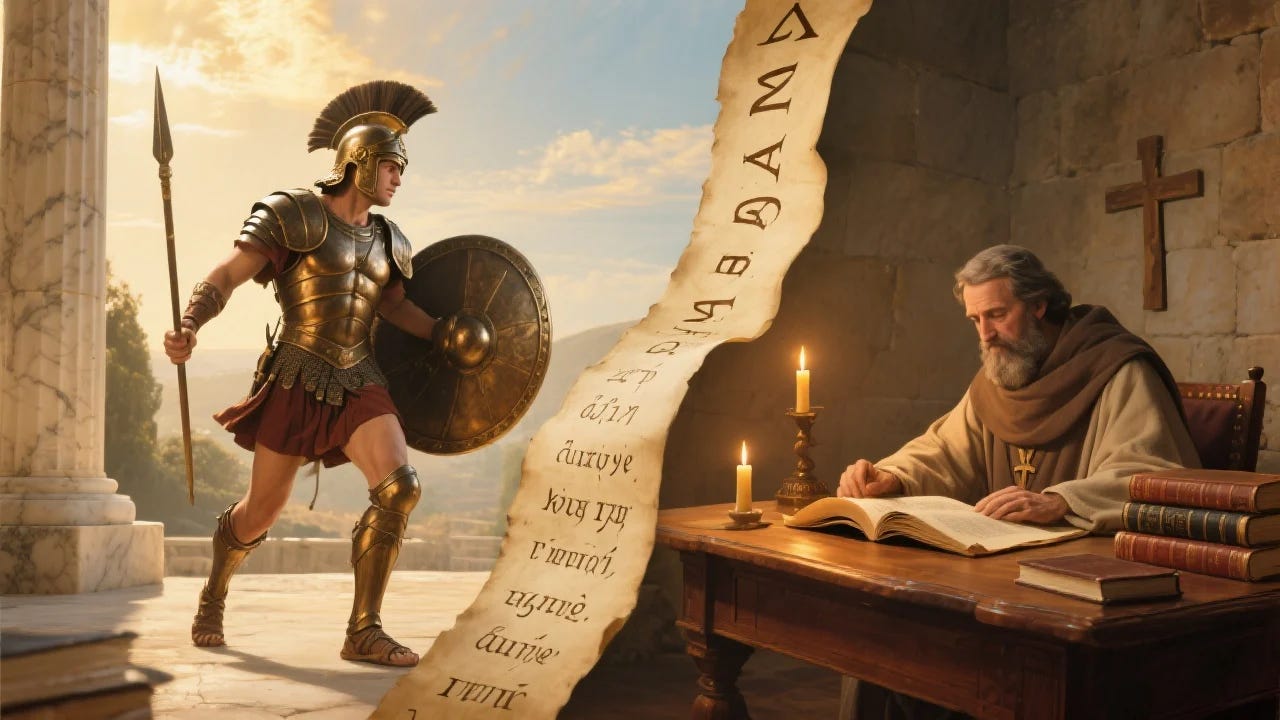
Homer’s heroes expressed the ideal values that nourished the souls of ancient Greek children for over seven-hundred years. It was not until much later, more than seven centuries (dating Homer around the mid 8th century BC) that the advent of Christianity changed the culture of classical education:
“It was not until long afterwards, when the Christian Faith decided to organize culture and education around the Book of Books – the Bible, the source of all knowledge and all life – that the literary man of antiquity finally became a scribe.” 5
St Basil the Great provides an insightful example of how the scribe culture of Christianity, over 1,000 years after Homer, still integrated the wisdom of Achilles and Christ.
Basil of Caesarea (AD 329 - 379) was not only a famous Christian bishop but also a scholar and teacher. Together with his brother Gregory of Nyssa and their mutual friend Gregory of Nazianus, their significant intellectual and moral leadership during the critical fourth century led them to be remembered in church history as the ‘’Cappadocian Fathers.’’
Basil’s broad education illustrated the importance of integrating ‘’Athens and Jerusalem.’’ Educated not only in his hometown of Caesarea but also in Constantinople (New Rome) and Athens. “His literary education steeped him in Greek epic and lyric poetry, plays, history and Platonic philosophy.’’ 6
He wrote a sermon called ‘’To Young Men, on How They Might Derive Profit from Pagan Literature.’’ As evident in the title, this famous church father of the Greek East instructed how Christians should respond to classical, pagan culture and learn from it.
So we also must consider that a contest, the greatest of all contests, lies before us, for which we must do all things, and, in preparation for it, must strive to the best of our power, and must associate with poets and writers of prose and orators and with all men from whom there is any prospect of benefit to the care of our soul. 7
The ultimate contest for Basil, what the Greeks called agon, [the same word used for battle, struggle and athletic competition] is the ‘’care of our soul.’’ Basil exhorted ‘’let us not fail to derive advantage” from ‘’passages in literature which contain an admonition of excellent things’’ in which ‘’the virtuous deeds of men of old have been preserved for us.’’
How do we do this? Basil suggests that we should be like bees, ‘’for those neither approach all flowers equally, nor in truth do they attempt to carry off entire those upon which they alight, but taking only so much of them as is suitable for their work, they suffer the rest to go untouched.’’ 8 Or to quote the famous martial artist Bruce Lee, “Absorb what’s useful. Disregard the rest.’’
What do we read? Although unfortunately Basil doesn’t leave behind a detailed reading plan, the various writers he mentions in his sermon does give us guidance on what we should read. The classical reading plan included literature (epic poetry and plays), history, philosophy and religion. Classical Greek poets and historians like Homer, Hesiod and Plutarch are all referenced in his sermon, in addition to stories about Hercules and Pericles. The focus is on a ‘’devotion to wisdom’’ to help us acquire virtue (arete) and to avoid vice.
Basil’s sermon influenced the future of western educational culture. It was cited in the Renaissance, recommended in the Jesuits’ Ratio Studiorum, their foundational document of education and used by sixteenth century reformer John Calvin, "'to defend a broad appropriation of the wisdom of the ancients.” 9
Paideia Becomes Humanitas
Mousiki was also part of the Hellenic idea of paideia. Paideia was the cultural and educational ideal that inspired and supported the growth of the ancient world for many centuries. Its goal was to create excellent men as part of excellent societies.
...as means to a good life paideia [education] and arete [virtue, excellence] would make the most just claim.
- Aristotle, Politics 3.1283a
You may find the word paideia strange because you don’t understand the ancient Greek word. But rest assured, you know the concept, at least in its modern form. The Romans wholeheartedly embraced the ideal of paideia and passed the idea on to our modern education. The Romans translated paideia into Latin using the word humanitas. This meant the essence of being human.
Renaissance scholar James Hankins writes that humanitas ''in the widest sense of an education meant to bring out our full human potential, intellectual and moral. '' It was ''the belief that certain forms of study—the study of languages, literature, history, eloquence, and above all philosophy—are tools inherited from our revered ancestors that enable us to improve ourselves and the quality of human beings generally." 10
Humanitas in the Renaissance was a revival and reinterpretation of classical humanism. This original ideal of humanism - paideia in Greek - had a focus on cultivating greatness. Here Marrou makes the important connection for us, again:
“Classical humanism was able to lead to – and in fact lead to – a higher kind of greatness, by putting itself at the service of a higher cause, to which the human person was willing to consecrate himself and thus find fulfilment in self-transcendence.’’ 11
We've come to know ancient Roman humanitas in our modern world as humanities. We strive to reach our moral and intellectual potential and achieve wisdom through the humanities. Reading the classical texts of the humanities – such as literature, history, and philosophy – helps us cultivate the love of wisdom, philosophia for the ancient Greeks.
Reading well is a crucial part of living well.
An important tool for moral and intellectual growth in the classical western tradition was literature. Aristotle in his Poetics wrote that an element of good literature was that it “satisfies the moral sense.” In A Defense of Poetry Renaissance author Sir Philip Sidney wrote that the very purpose of literature was 'the winning of the mind from wickedness to virtue'' and inflaming a reader with a "desire to be worthy.'' 12
The ancient Greeks realized that literature, and the other topics of the future ''humanities"- such as history, philosophy, poetry, music - can strengthen the moral life of the reader. It's why Plato had mousiki (the art of the muses) as the second part of his leadership growth program.
In the next lesson we will see how Plato used a Greek word for training, askesis, to help us re-orient our minds towards timeless, eternal truths.
Notes
H.I. Marrou, A History of Education in Antiquity, p. 9
H.I. Marrou, A History of Education in Antiquity, p xiv
H.I. Marrou, A History of Education in Antiquity, p xiv
H.I. Marrou, A History of Education in Antiquity, p. 12
H.I. Marrou, A History of Education in Antiquity, p.xiv
Richard M. Gamble, The Great Tradition, Basil the Great p. 181
Basil the Great, ’To Young Men, on How They Might Derive Profit from Pagan Literature.’’
Basil the Great, ’To Young Men, on How They Might Derive Profit from Pagan Literature.’’
Richard M. Gamble, The Great Tradition, Basil the Great p. 181-182
James Hankins, Liberal Learning beyond Liberalism: The Humanities as Soulcraft in the Renaissance and Today https://www.thepublicdiscourse.com/2020/06/64818
H.I. Marrou, A History of Education in Antiquity, p. 226
On Reading Well: Finding the Good Life through Great Books . Baker Publishing Group. Kindle Edition. (Intro Leland Ryken)