

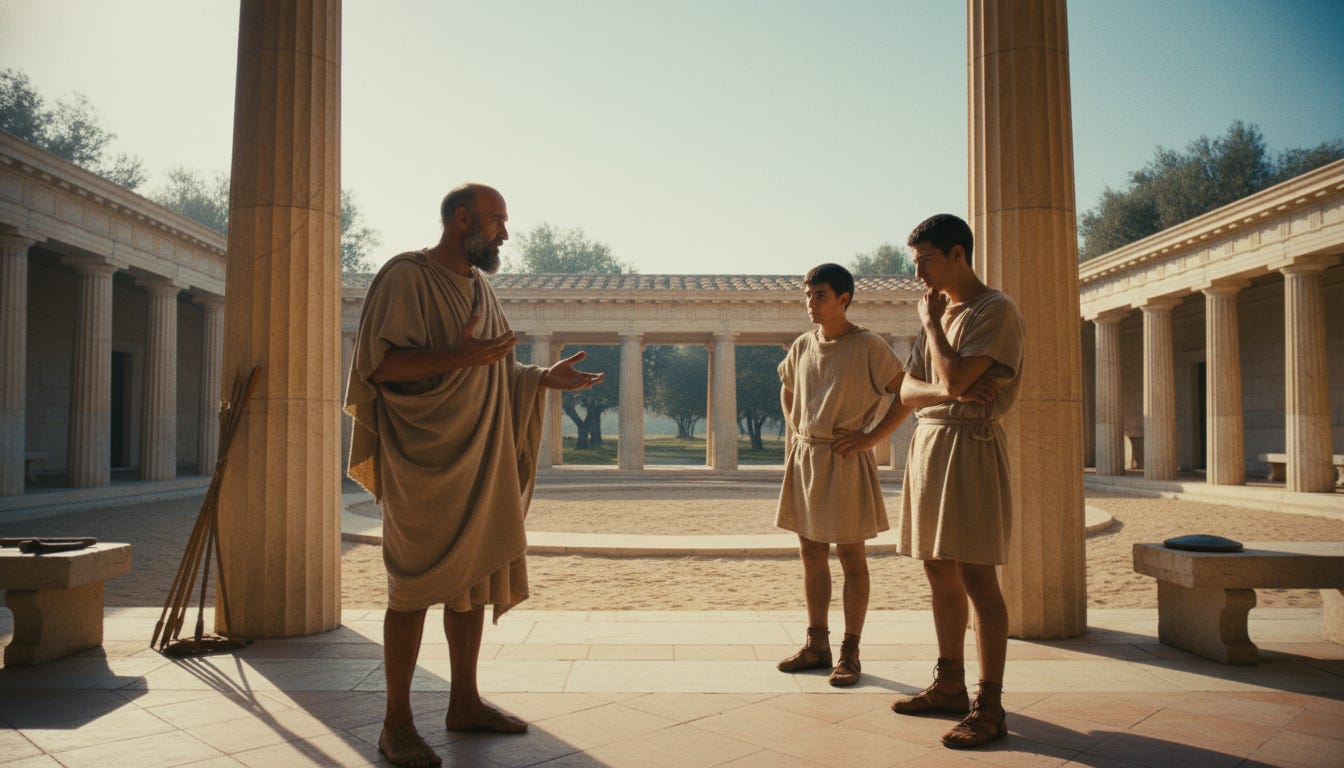
For just as those who take care of their bodies do not give them unlimited freedom in matters of eating and drinking, but set a limit to these things in accordance with what will best preserve the body, so too those who take care of the soul… do not let it go wherever it wishes, but exercise it in things which will make it better.
- Socrates on training the soul; Xenophon, Memorabilia 1.5.2
Morality and goodness were the ultimate goal for Socrates. His vision, as expressed through Plato, can be summed up as something like – beautiful souls, in strong bodies, struggling to know goodness and to be Good.
To help leaders (guardians, philosopher-kings) achieve this goodness, Socrates, Plato and a range of other Greco-Roman philosophers advocated for philosophy. A philosopher in the Socratic understanding was someone who loves and pursues the Good by loving and pursuing wisdom - philosophia, the love of wisdom.
Askesis: Disciplined Training of the Soul Toward Virtue
But how do you go from loving wisdom to becoming wisdom?
This required practicing philosophy as a way of life. And this required effort, struggle and training.
Exercise and effort, these philosophers taught, was required to achieve wisdom and know what the good was. To explain the practices needed to achieve this excellence they used another Greek word from the field of athletics and competition – askesis.
For Socrates and Plato arete (virtue and excellence) was understood as a kind of harmony and health of the soul 1 . And like physical, bodily health, achieving arete requires exercise or training.
The word the Greeks used for training was askesis. Achieving excellence and virtue (arete) must be earned through competition and training.
Askesis as understood and practiced by the Greek philosophers was a disciplined training of the soul toward virtue. Socrates taught his followers to exercise their souls to make it better. Socrates and all of his ‘’children’’ and their schools - Plato, Aristotle, Epictetus (Stoics) and even Epicurus - all embraced this concept of training the soul towards goodness and excellence.
Socrates was the coach and mentor at the philosophical gymnasium. He is the master of virtue, showing up at gymnasiums, to train his students. Socrates engages in dialectical/philosophical struggle and competition, whose goal is wisdom. Virtue, and specifically wisdom, was the most common goal of Socrates, as he showed up in Plato’s dialogues, to challenge the leaders of Athens. In the dialogue of Euthydemus, Socrates challenges us to ‘’pay no attention to the practitioners of philosophy but rather to the thing itself...to take it to heart, pursue and practice it [askesis]’‘. 2
This “thing itself “ is philosophy as a way of life. And the transformation came through the ‘’practice,’‘ what the Greeks called askesis.
The West’s First Spiritual Exercises: Effort & Training in your Whole Way of Being
This ‘philosophical askesis’ are in fact spiritual exercises. They are “exercises” because they require effort and training, and they are ‘’spiritual’‘ because they impact one’s ‘whole way of being.’ The goal of these exercises was to help the practitioner live a philosophical life:
Hence, the teaching and training of philosophy were intended not simply to develop intelligence of the disciple, but to transform all aspects of his being – intellect, imagination, sensibility, and will. Its goal was nothing less than an art of living, and so spiritual exercises were exercises in learning to live the philosophical life.
Spiritual exercises were exercises because they were practical, required effort and training, and were lived; they were spiritual because they involved the entire spirit, one’s whole way of being. The art of living demanded by philosophy was a lived exercise exhibited in every aspect of one’s existence. 3
- Pierre Hadot, Philosophy as a Way of Life
The first spiritual exercise we come across in Western civilization and Hellenic philosophy is the dialectic. We see this in the Socratic dialogues of Plato. Socrates’ famous maxim is to ‘’know thyself.’‘ We have to give attention to and care for ourselves. These Platonic dialogues show us that what is most important is not the solution itself but the path we have to traverse to arrive at our particular problem. According to the late French historian of Hellenic philosophy, Pierre Hadot, the Socratic dialogues was a
...concrete and practical exercise, because, to be precise, it is not concerned with the exposition of a doctrine, but with guiding an interlocutor to a certain settled mental attitude: it is a combat, amicable but real. We should note that this is what takes place in every spiritual exercise; it is necessary to make oneself change one’s point of view, attitude, set of convictions, there to dialogue with oneself, there to struggle with oneself. 4
Spiritual exercises can be observed in Hellenistic and Roman schools of philosophy. The Greek Stoic philosopher Epictetus would also teach philosophy as a way of life. In his most famous work, Discourses, he uses metaphors of exercise and competitive athletic contests to describe an ideal of seeking the beautiful. Epictetus uses words like “askesis” (training), “agon” (the Greek ideal of competitive struggle), and the verb “gumnazo’‘ “(to exercise, where we get our words gymnastics and gymnasium) approximately 50 times in the Discourses. 5
What advantage does a wrestler gain from his training partner? The greatest. And that man, too, who insults me becomes my training partner; he trains me in patience, in abstaining from anger, in remaining gentle.
– Epictetus, Discourses 3.20.9
Socrates philosophical students and “descendants’‘ created four main schools of philosophy: Plato (the Academy), Aristotle (the Lyceum), Epicurus (the Garden) and Zeno (the Stoa, where we get Stoicism) and to a lesser degree, the Cynics and Skeptics. All these schools agreed that
‘’mankind’s principal cause of suffering, disorder, and unconsciousness were the passions: that is, unregulated desires and exaggerated fears. People are prevented from truly living, it was taught, because they were dominated by worries. Philosophy thus appears, in the first place, as a therapeutic of the passions. Each school had its own therapeutic method, but all of them linked their therapeutics to a profound transformation of the individual’s mode of seeing and being. The object of spiritual exercises is precisely to bring about this transformation. 6
This transformation was tough; a sort of inner metamorphosis. That’s where spiritual exercises, askesis, came in. We saw that Socrates introduced the dialogue and dialectic as an exercise. But we have a number of other exercises that the Greek and Roman philosophers taught.
Plato, Socrates most famous student, can be seen as the first Western philosopher to espouse an integrated approach to one’s growth (what in the 21st century we’ve come to know as body, mind and spirit). He taught the following exercises in his dialogues:
Daily self-mastery: ‘’as Dion and I used to advise Dionysius [Dionysius the Younger: Greek political leader in ancient Syracuse, Sicily 397-343 BC], first of all to make his daily life such as to give him the greatest possible mastery over himself’‘ - Plato, Seventh Letter 331 d
Eat a moderate diet: “According to the philosopher, a moderate and thus a healthy diet, consists of cereals, legumes, fruits, milk, honey and fish. However, meat, confectionery and wine should be consumed only in moderate quantities.’‘ 7
Love of virtue instead of pleasure: ‘’and he resolved to spend the rest of his life: differently from most Italians and Sicilians, since he had come to love virtue more than pleasure or luxury.’‘ - Plato, Seventh Letter 327b
Pursuit of virtue: “...he should induce others among his relatives and companions to become friends and partners in the pursuit of virtue...’‘ ‘’Let him take the path we pointed out and perfect himself in wisdom and self-control.’‘ and ‘’..no individual can be happy except by living in company with wisdom under the guidance of justice, either from personal achievement of these virtues or from right training and education...’‘ - Plato, Seventh Letter 332 d,e and 335 d,e
Reflection & training our minds: reflection, ‘’under the guidance of reason, to make the best possible use of one’s situation....we should constantly be training our minds.’‘ - Socrates, Republic, 404 c
Exercise love of learning and transcendent wisdom: ‘’On the other hand, if a man has seriously devoted himself to the love of learning and to true wisdom, if he has exercised these aspects himself above all, then there is absolutely no way that his thoughts can fail to be immortal and divine...keeping well-ordered the guiding spirit that lives within him, he must indeed be supremely happy.’‘ - Plato, Timaeus 90 c
Philosophical exercise for Plato was not just intellectual—it was transformative, leading to wisdom and a higher state of being.
Stoic-Platonic Exercises: Self-awareness, Intellectual and Practical
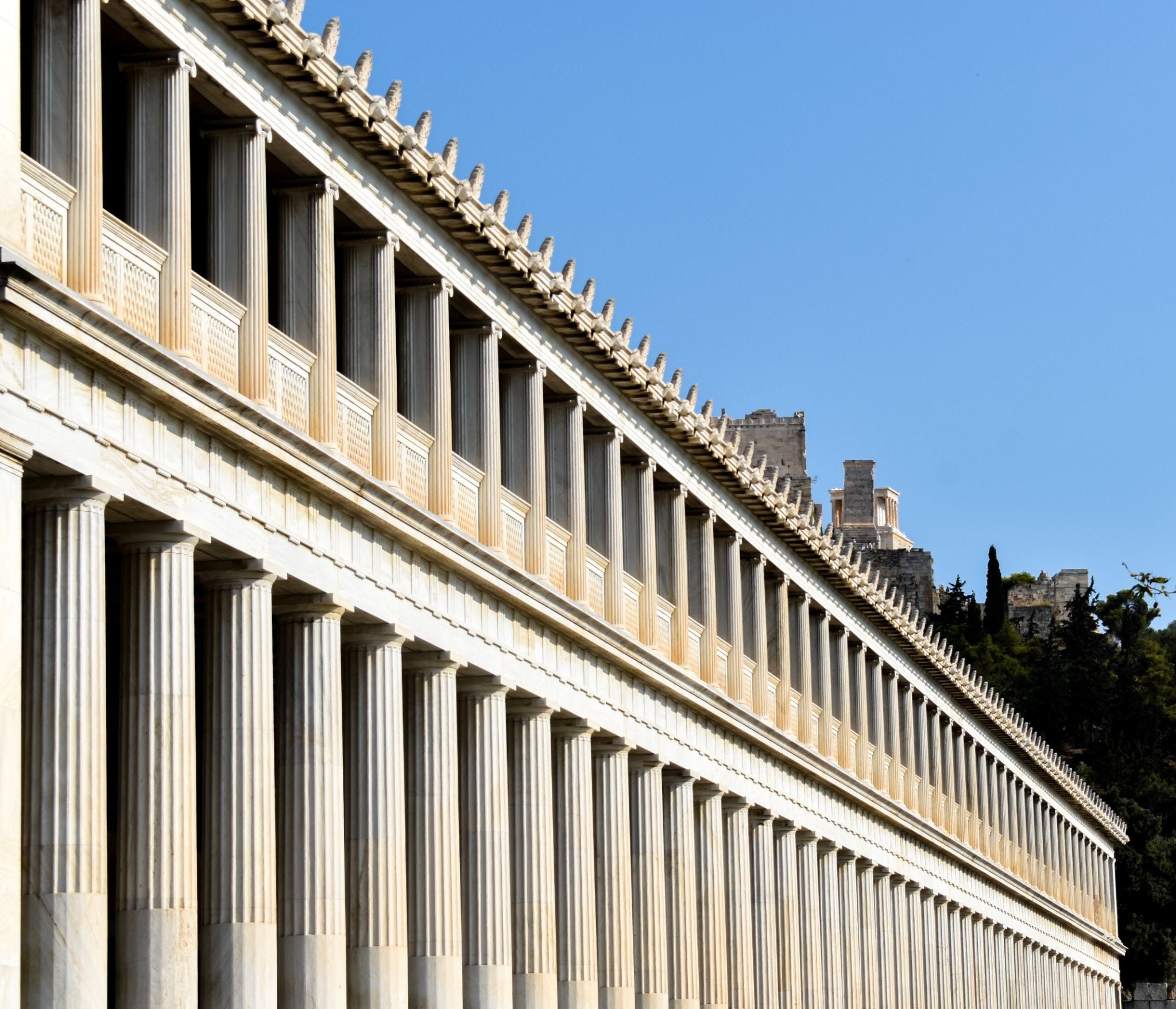
Source: Wikimedia Commons: Stoa of Attalos, Athens, Greece.
There was no systematic guidebook or treatise in the ancient Greek world that outlined all the spiritual exercises of the Hellenic philosophers in one place. We do know that these spiritual exercises were well known since they were part of the daily life at the philosophical schools. But thanks to Philo of Alexandria, according to Pierre Hadot, we do have two lists of spiritual exercises. 8
Philo is an important source for us. He was a Hellenistic Jewish philosopher who lived in the Roman province of Egypt (20 BC – 50 AD) and was a contemporary of Jesus Christ. Philo bridges the Hellenic and Judeo sources of wisdom which became the foundation of our western culture. Philo wrote in Koine Greek about philosophy, religion and politics. Important for our analysis of spiritual exercises, Philo explored connections between Greek Platonic philosophy and Second Temple Judaism, combining the God of the Old Testament with the Platonic idea of the Good. 9
Here is a summary of the ‘’Stoico-Platonic’ inspired philosophical therapeutics’‘ that Philo listed in his writings, grouped into three categories: self-awareness, intellectual and practical.
Self-awareness meant interior exercises to train and control inner discourse. Here were specific exercises the Platonic and Stoic schools taught:
Attention (Greek: prosoche): “Attention to the present moment is, in a sense, the key to spiritual exercises... It is a continuous vigilance and presence of mind, self consciousness which never sleeps. Attention to the present moment allows us to accede to cosmic consciousness, by making us attentive to the infinite value of each instant, and causing us to accept each moment of existence from the viewpoint of the universal law of the cosmos. ‘’ 10
Meditation (Greek: meltai): “The exercise of meditation allows us to be ready at the moment when an unexpected – and perhaps dramatic – circumstance occurs…The goal is to use thought exercises to help focus on what we can and cannot control…The first thing in the morning and in the evening, we should examine ourselves to become self-aware; aware of the progress we have made and the faults holding us back. 11
Intellectual exercises were used to train philosophical understanding. Here the activities were reading, research, listening and investigation. The goal was to provide ‘’food for meditation:” reading and researching the texts of poets and philosophers
This learning would be often summarized in pithy maxims, sayings or proverbs called apophthegmata in Greek. These sayings would be memorized to be at hand and readily called upon during meditation. 12
The final category were practical exercises, everyday exercises, to develop virtuous habits. The first of these was self-mastery, as Plato said above; “make his daily life such as to give him the greatest possible mastery over himself.’ This required an indifference to indifferent things, and applied to all men as they fulfilled their duties of social life and being a good citizen.
Fortunately for us there are a number of treatises relating to these practical exercises that are extant, still in existence. For example, the Platonist philosopher and historian Plutarch and the Stoic philosopher Seneca specialize in these moral and ethical texts. Plutarch’s Moralia include writings titled: On Restraining Anger, On Peace of Mind, On Brotherly Love, On the Love of Children, On the Love of Wealth, On False Shame, On Envy and Hatred. Seneca created works in the same genre with titles such as On Anger, On Benefits, On Peace of Mind and On Leisure.
In the next lesson we will continue with askesis. We will discover what happens when Hellenic philosophy comes into contact with the ‘’philosophy’ of Christianity.
Notes
Plato frequently uses the analogy of virtue as health. For example, in The Republic 444d-e
Euthydemus 307c
Pierre Hadot, Philosophy as a Way of Life, introduction, Arnold I Davidson, p21
Pierre Hadot, Philosophy as a Way of Life, introduction, Arnold I Davidson, p20
Heather Reid, Olympic Philosophy: The Ideas and Ideals behind the Ancient and Modern Olympic Games (p. 193). Parnassos Press – Fonte Aretusa. Kindle Edition)
Pierre Hadot, Philosophy as a Way of Life. p. 83
Dietetics in ancient Greek philosophy: Plato’s concepts of healthy diet, European Journal of Clinical Nutrition, 2001 55, 532-537: https://link.springer.com/article/10.1038/sj.ejcn.1601179
Pierre Hadot, Philosophy as a Way of Life, p. 84
Philo of Alexandria: https://en.wikipedia.org/wiki/Philo.
Pierre Hadot, Philosophy as a Way of Life, p. 84-85
Pierre Hadot, Philosophy as a Way of Life, p. 85
Pierre Hadot, Philosophy as a Way of Life, p. 86