

Socrates: Anyone who is going to be a truly good guardian of our community, then, will have a philosopher’s love of knowledge, and will be passionate, quick on his feet, and strong.
Glaucon: How shall we educate them, then? Or is it hard to improve on the educational system which has evolved over a long period of time? This, as you know, consists of exercise for the body and cultural studies for the mind.
Socrates: Yes
Glaucon: And shall we begin the cultural programme before the physical one?
Socrates: Of course.
- Plato, Republic, Robin Waterfield Translation, 376c-376e
I thought I had a good daily workout routine. But Plato challenged my thinking and habits.
“Every cadet an athlete” - Physical Training Ethos at West Point
When I transitioned from the military to the civilian world I tried to build upon the good habits of exercise that I learned in the military. I prioritized physical training (PT) in the morning like we did when I was an Army officer.
It’s a habit that I learned at West Point. The United States Military Academy (USMA) has cultivated a holistic training philosophy for over two centuries that revolves around one central maxim: “Every cadet an athlete.” This phrase reflects West Point’s belief that physical competence is inseparable from leadership, character, and the profession of arms.
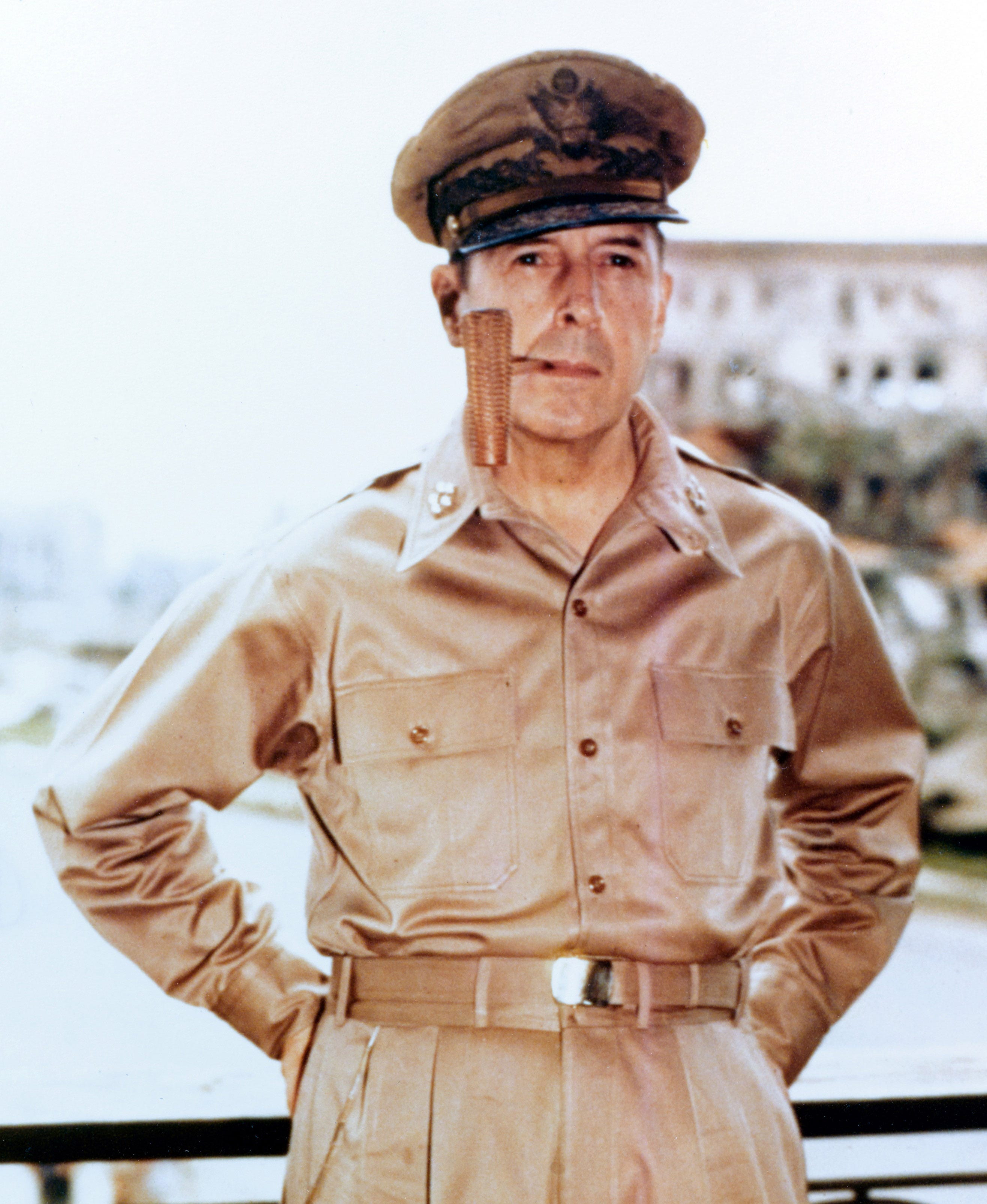
Upon the fields of friendly strife are sown the seeds that, upon other fields, on other days, will bear the fruits of victory.
- General Douglas MacArthur
These are the Physical Program Components of West Point, which have continued to improve since I’ve graduated:
Daily Physical Training (PT): Cadets develop aerobic fitness, muscular endurance, and combat readiness.
Mandatory Physical Education (PE): Courses include boxing, wrestling, military movement, survival swimming, and lifetime sports.
Competitive Sport Requirement: Each cadet participates in varsity, club, or intramural athletics. This ensures competitive spirit, sportsmanship, resilience, and teamwork.
Fitness Testing: The Indoor Obstacle Course Test (IOCT), Cadet Fitness Assessment (CFA), and Army Combat Fitness Test (ACFT) benchmark cadets against demanding standards.
Now as a civilian my routine wasn’t as comprehensive or structured as at West Point. But I was combining strength training with some running, biking and a weekly pick up game of basketball, where possible.
I thought I was training well.
Then I re-read Plato.
Plato’s Cultural Workout
As I was reflecting on my West Point experience, I was re-reading a book I hadn’t picked up in years. Having studied Humanities and Public Affairs (H&PA) at West Point I was a deep fan of the classic books of the Western Tradition. I hadn’t read the Republic since my political philosophy class. As is usually the case with the Great Books, my second reading revealed deeper insights that I missed, or wasn’t ready for, during my first reading.
A good book gets better on the second reading. A great book on the third. Any book not worth rereading isn't worth reading. - Nassim Nicholas Taleb
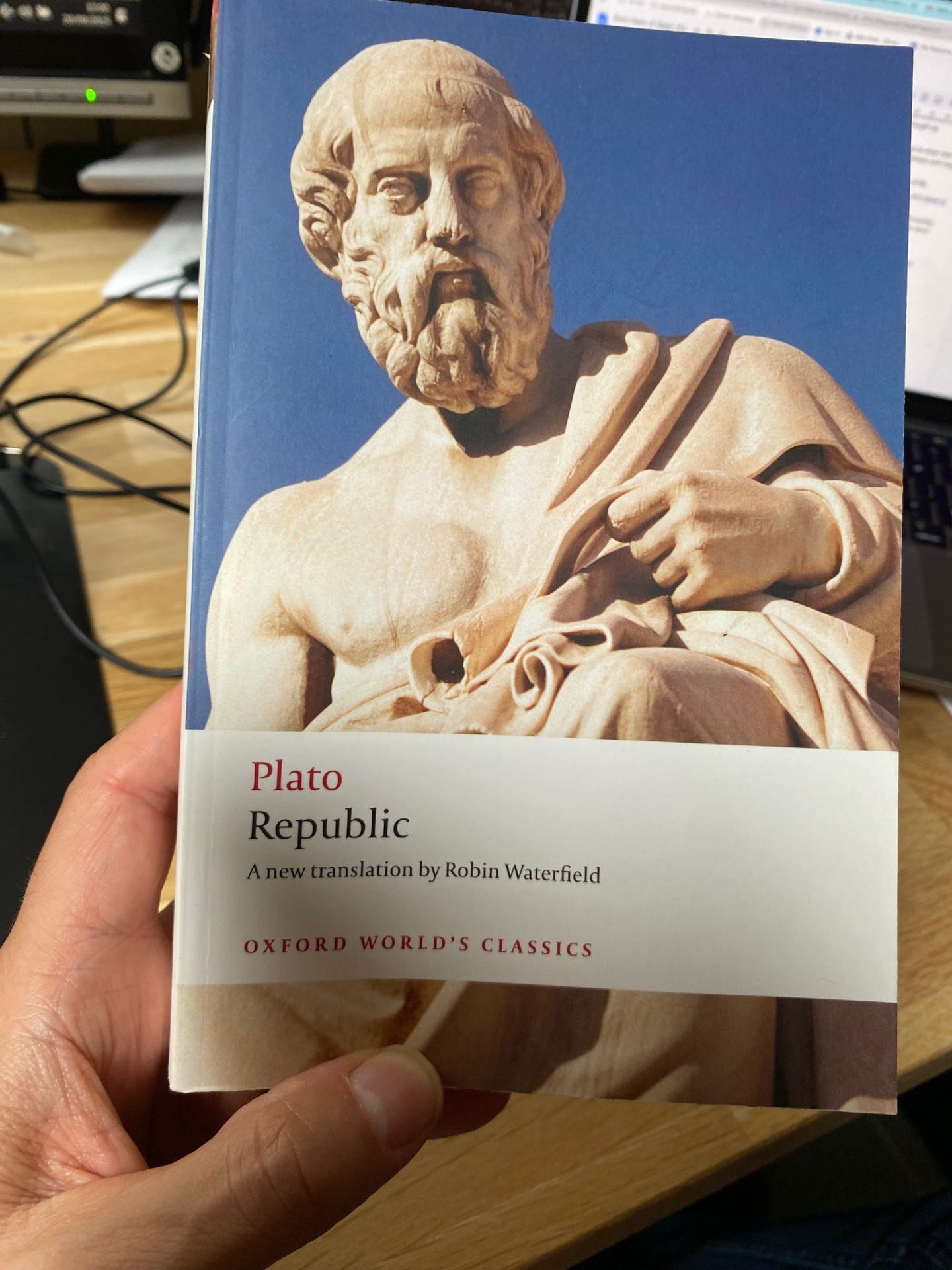
I was struck by two things upon my second reading of the Republic. One, Plato’s book may be known as a great work on philosophy and politics but he spends lots of time on education and training of leaders. Two, this leadership training program prioritized not only physical but also cultural training.
I was moved by Plato’s vision of a harmonious blend of culture and physical exercise. In Plato’s telling, through his favorite speaker Socrates, we become a ‘’virtuoso’’ and have the “most harmony” in life, if we apply the physical and the cultural in ‘’the right proportions.’’
Socrates: ‘So in my opinion what we find is that, since we have a dual nature, God gave us two corresponding areas of expertise—culture and physical exercise—for our passionate and our philosophical aspects. He didn’t give them for the mind and the body, except incidentally; the purpose was for those two aspects of our nature to fit harmoniously together by being stretched and relaxed as much as is appropriate.’
Glaucon: ‘Yes, that seems to be so,’ he said.
Socrates: ‘Therefore, it isn’t the person who attunes the strings of a lyre to one another, it’s the person who makes the best blend of physical exercise and culture, and who applies them to the mind in the right proportions, whom we should really describe as a virtuoso and as having the most harmony in his life.’
Glaucon: ‘That’s hard to deny, Socrates,’ he said.
Socrates: ‘So, Glaucon, we’ll always need someone of this type to oversee our community, if its political system is to remain intact, won’t we?’
- Plato Plato, Republic, Robin Waterfield Translation, 412a-b
I understood physical exercise but what did Plato mean by ‘’culture?’’ The original Greek word was “mousiki’’ so most modern translators call it ‘’music.’’ But that’s not quite accurate. Mousiki meant all the art of the Muses. It was the whole moral and intellectual training through literature, poetry, myths, history, philosophy and yes, music.
We see this cultural impact through ancient Greek history. Plato called Homer the educator of Greece. In The Republic he wrote about ‘’those who praise Homer and say that he’s the poet who educated Greece,’’ (Republic 606e). There were many testimonies that every cultivated Greek had Homer next to their bedside, like Alexander the Great did during his campaigns.
The importance of reading classical books continued in the Christian era. The famous Christian Bishop St. Basil of Caesarea (AD 329 - 379), remembered as one of the “Cappadocian Fathers,’’ gave specific advice on the importance of reading for the care of our soul. He wrote a sermon called ‘’To Young Men, on How They Might Derive Profit from Pagan Literature.’’ As evident in the title, this famous church father of the Greek East instructed how Christians should respond to classical, pagan culture and learn from it.
So we also must consider that a contest, the greatest of all contests, lies before us, for which we must do all things, and, in preparation for it, must strive to the best of our power, and must associate with poets and writers of prose and orators and with all men from whom there is any prospect of benefit to the care of our soul.
The ultimate contest for Basil, what the Greeks called agon, [the same word used for battle, struggle and athletic competition] was the ‘’care of our soul.’’ Basil exhorted ‘’let us not fail to derive advantage” from ‘’passages in literature which contain an admonition of excellent things’’ in which ‘’the virtuous deeds of men of old have been preserved for us.’’
So this ‘’cultural workout” was an important part of the Classical, Western Tradition in cultivating wisdom and caring for our soul.
But how could I apply these insights into my personal growth routine?
The Marine Corps’ Reading Lists - a “30 Year Old Body and 5000 Year Old Mind”
Professional reading has long been seen across the U.S. military as a crucial way to sharpen intellect, cultivate judgment, and connect warfighters to the tradition of their profession. While individual commanders had long stressed the habit—George Washington ordered the study of military history, and officers at West Point were encouraged to read widely in the 19th century—the practice was formalized much later. The U.S. Marine Corps was the first to institutionalize it in 1989 with General Al Gray’s Commandant’s Professional Reading List (CPRL), requiring every Marine to read works on history, leadership, and strategy as part of their professional military education.
The Marines knew that mental preparation was just as important as physical conditioning to succeed in their profession. In fact, another Commandant, General Amos, in a 2012 letter to the Marine Corps succinctly explained the purpose of this reading program: It was about attaining a “30 Year Old Body and a 5000 Year Old Mind.’’ General Amos further explained:
As it was once wisely put, reading provides a “better way to do business.. it doesn’t always provide all the answers.. but it lights what is often a dark path ahead.” Any book thoughtfully read sharpens the mind and improves on an individual’s professional potential.
The Marine Corps Professional Reading Program underwent a significant shift in its structure, moving from a rank-based system to one organized by subject-based categories. This change, which became more pronounced around 2020, aimed to make the list more relevant, current, and conducive to broader professional discussions among all Marines.
Here is an overview of the latest Marine Corps reading list (as of 2025): You’ll find the list divided into the following subject-based categories:
Heritage
Innovation
Leadership
Strategy
Foundational
Commandant’s Choice
In essence, the Marine Corps moved from a prescriptive, rank-specific reading requirement to a more flexible, thematic approach that empowers individual Marines to take greater ownership of their professional development through reading.
I was fascinated by the idea of a large, organized professional reading list that helps develop character and professional excellence.
It got me thinking: how can I channel the Marines’ idea for my own use?
How do I create my own life-long reading list that supports my moral and intellectual growth?
In other words, how do I develop my own ‘’5000 year old mind?’’
A Daily Workout of Wrestling with Great Books

“When evening comes, I return to my house and go into my study. At the door, I take off my clothes of the day, covered with mud and mire, and I put on regal and courtly garments; and decently re-clothed, I enter the courts of ancient men, where, received by them lovingly, I feed on the food that alone is mine and that I was born for… For four hours I feel no boredom, I forget every pain; I do not fear poverty; death does not frighten me.”
- Machiavelli’s (1513 letter to Francesco Vettori)
At first I imitated the ancient Greeks intellectual priorities and started reading Homer. To complement my morning physical training I picked up the Iliad to add some stimulating evening reading. I then continued with the Odyssey and added other Greek classics like Herodotus’ Histories and some of Plato’s dialogues.
What I discovered was no casual, relaxed reading experience but a real workout in wrestling with the ideas and concepts of these Great Books. Reading these classic books was a real mental & intellectual workout like exercising my body was a physical workout. I began to channel Machiavelli’s wisdom above and made my evening reading an experience where ‘’I enter the courts of ancient men, where, received by them lovingly…’’
I now have a lifetime reading list of 300 Great Books of the Western Tradition. It’s a list of classic books that I have collected - and am collecting - over the years. I use it as a source of reading to add to my cultural workout. See this post here where I share the complete list and how I came up with the culturally significant number of 300.
Collect books, even if you don’t plan on reading them right away. Nothing is more important than an unread library.” — John Waters
Alternating Old and New: Lewis’s Rule of Life for Readers
Plato gave me the “cultural workout.” C.S. Lewis gave me the cadence.
In his essay “On the Reading of Old Books” (originally an introduction to St. Athanasius’s On the Incarnation), Lewis argues that we should meet great minds face to face, not only through modern commentators. Firsthand reading is usually clearer and more delightful than secondhand summaries, and—crucially—old books correct our era’s blind spots. Modern books are “still on their trial” and need to be tested against the long tradition.
Lewis’s practical rule became the rhythm of my evening reading:
“It is a good rule, after reading a new book, never to allow yourself another new one till you have read an old one in between. If that is too much for you, you should at least read one old one to every three new ones.”
Why? Because every age is brilliant at some truths and blind to others. We need voices from other centuries to challenge our assumptions:
“Every age has its own outlook… We all, therefore, need the books that will correct the characteristic mistakes of our own period. And that means the old books.”
And then the image that sealed it for me:
“The only palliative is to keep the clean sea breeze of the centuries blowing through our minds… People were no cleverer then than they are now; they made as many mistakes as we. But not the same mistakes.”
For me, the most important thing about reading these classic books wasn’t the book itself but the Great ideas, Great men (and women) and Great events that represented the best (and sometimes the worst) in virtue and human excellence. These ideas and lessons are timeless and appear in contemporary books as well.
I had fun implementing C.S. Lewis’ reading advice, alternating between old and new books, looking for contemporary books to complement the classic ones. Here are some example pairings I have used:
The Iliad by Homer followed by Where Men Win Glory: The Odyssey of Pat Tillman. This title of Tillman’s biography features 2 references to Homer (“Where Men Win Glory” is a line from the Iliad)
The Odyssey by Homer followed by An Odyssey: A Father, A Son and an Epic, about a classics lecturer, Daniel Mendelsohn (and now translator of Homer) and his relationship with his father.
Histories by Herodotus followed by Gates of Fire, Steven Pressfield’s classing re-telling of the Spartan last stand battle against the Persians, first told in Histories.
These books all show the timeless importance and relevance of classic virtues.
Putting it all together - Plato’s Workout
Plato’s approach to virtue-based leadership offers guidance and inspiration to my entire approach to working out. A student of Socrates and teacher to generations through his Academy, Plato designed a holistic curriculum to cultivate wise, virtuous leaders—those capable of blending power with philosophy.
We reviewed the importance Plato held for cultural development but his training protocol involved three essential disciplines:
“gymnastics” for physical excellence
“music” (the art of the Muses) for cultural refinement and wisdom, and
“dialectic” for philosophical examination and spiritual development.
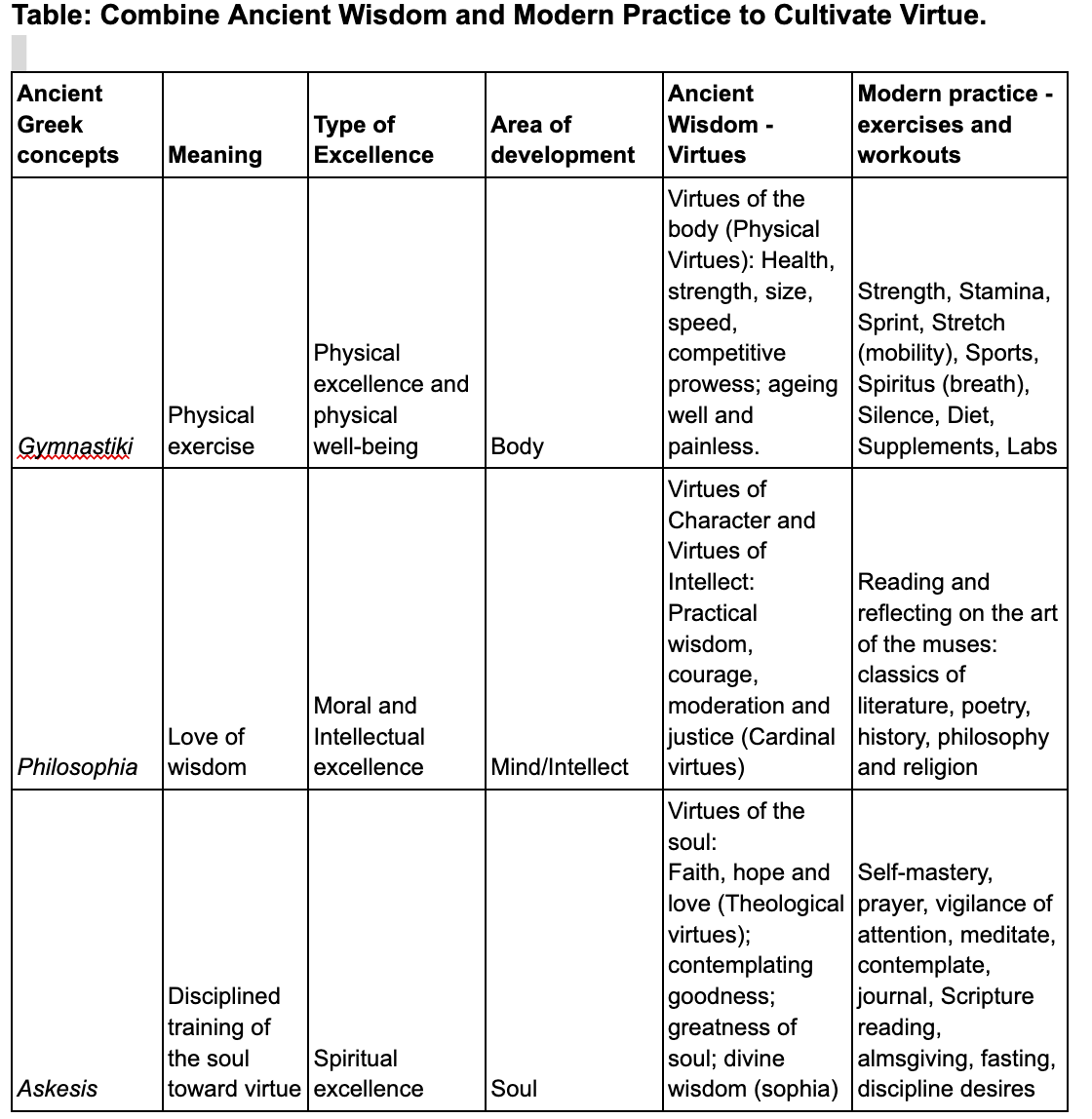
This combined approach was Plato’s program to cultivate virtue. And it can serve as a model for our daily workout:
“gymnastics” - exercise, diet, movement
“music” - reading books on literature, poetry, history, philosophy
“dialectic’’ - spiritual practice and self-mastery through meditation, contemplation, prayer and self-awareness
Plato’s Workout seeks to operationalize this ancient wisdom. I draw from Greek philosophy, Western literature and history, Christian spirituality, and modern science to help you flourish in body, mind, and spirit. Through physical training, disciplined habits, contemplation, and pursuit of virtue, we offer a modern path to ancient greatness.
Here is a summary of my approach, combining ancient wisdom and modern practice.
Join me in reviving the original integrated workout: one that strengthens the body, educates the mind, and saves the soul.
What to read next?
The Great Books: The lifelong reading list of the 300 best books from the Western Tradition
Plato’s Protocol Series, part 1: Why the famous ancient philosopher Plato is a great modern guide for personal growth.