

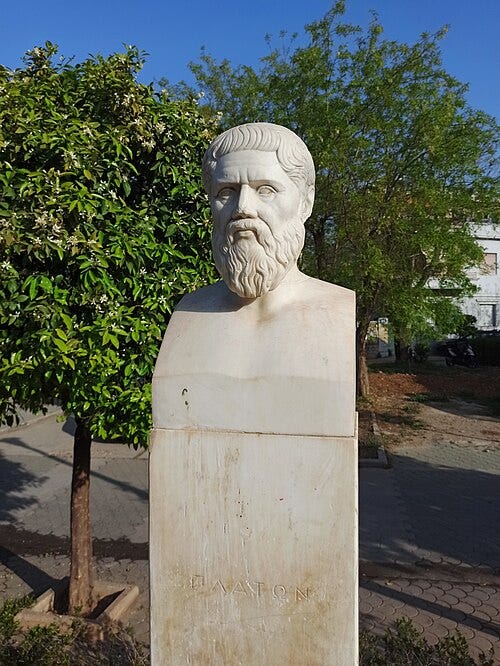
Head of Plato at Plato’s Academy in Athens, Wikimedia

Welcome to the Plato Protocol Series.
Our goal is to help you integrate ancient wisdom and modern practice to achieve excellence. Our holistic program will help you flourish, experiencing a deep well-being that enables you to excel morally, intellectually, spiritually and physically.
Think of this as a modern training plan for high performance, health and happiness inspired by Plato and the entire Classical, Western Tradition.
At first, this may sound like a counter-intuitive idea. One of the most famous western philosophers in all of history as a role model for our personal growth and leadership development?
Plato may seem like a strange example for us modern practitioners of personal development to emulate. But stick around to see how combining the insights from ancient Greek wisdom, Christian spirituality and modern health practices is the best approach for your personal growth.
You probably know Plato for his impact on philosophy. Ralph Waldo Emerson wrote that ‘’Plato is philosophy, and philosophy is Plato.’’ And the 20th century philosopher Alfred North Whitehead famously commented: “The safest characterization of the history of Western philosophy is that it is a series of footnotes to Plato.”
But consider the following:
Plato created the original Academy. Today we consider Plato’s school the first university and education institution. The word Academy has become associated with elite institutions and training programs due to its rich historical background and connotations of excellence, all inspired by Plato.
Plato’s famous school of philosophy was actually a gymnasium. The original ancient Greek gymnasiums were sports complexes and facilities which included wrestling schools, running tracks, a park for walks, baths and other buildings.
Plato’s Academy was part of the ancient Greek educational tradition (paideia) that integrated body and mind. Paideia was a comprehensive Greek educational concept that focused on the cultivation of the ideal citizen through a holistic approach to learning and personal development. This ancient Greek system of education aimed to create well-rounded individuals who embodied the highest virtues of their society. Plato’s Academy was part of this tradition.
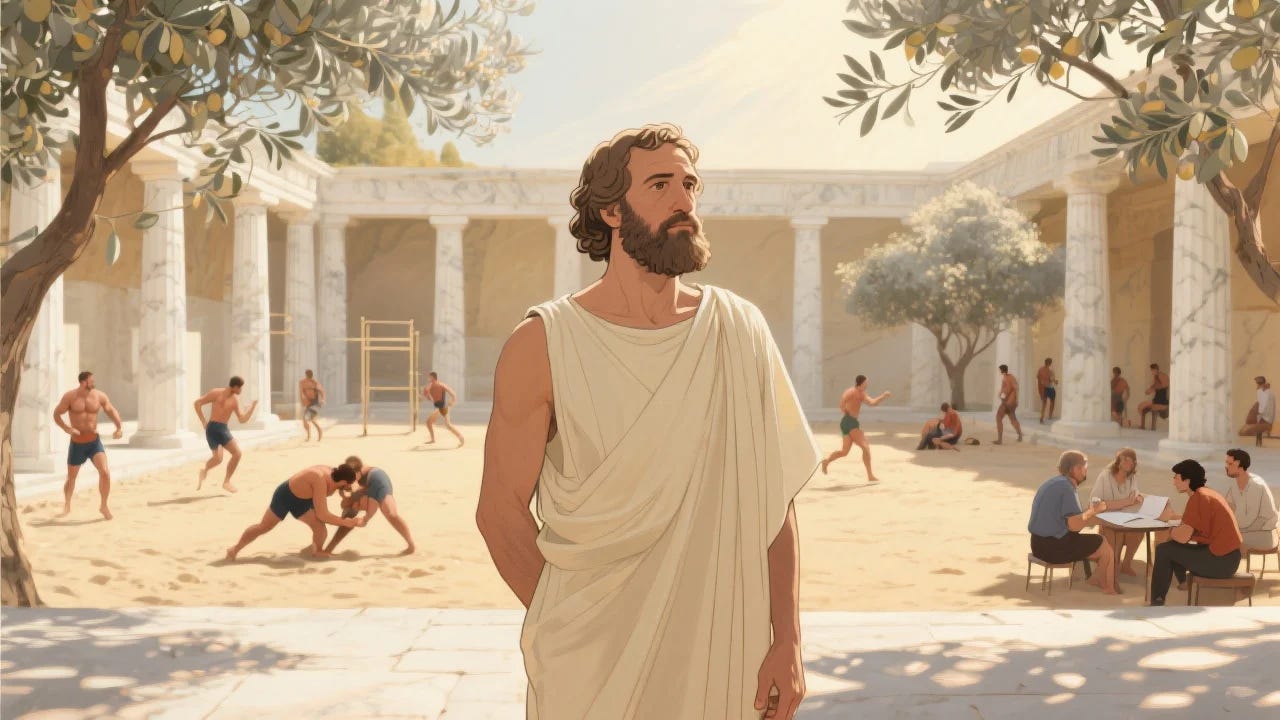
Plato’s gymnasium was designed to train beautiful souls in strong athletic bodies, and to dedicate them to a civic ideal of unity rather than strife. – Heather Reid, Scholar in ancient Greek philosophy
Plato’s philosophical vision was about a ‘’real union of philosophy and power.” Plato’s Seventh Letter (one of 13 surviving letters) is autobiographical in nature. It addresses his attempted involvement in the politics of the Greek city-state of Syracuse. Plato advocates for the combination of philosophy and political power; the idea which famously became known as the ‘’philosopher king.’’.
At last I came to the conclusion that all existing states are badly governed and the condition of their laws practically incurable, without some miraculous remedy and the assistance of fortune; and I was forced to say, in praise of true philosophy that from her heights alone was it possible to discern what the nature of justice is, either in the state or in the individual, and that the ills of the human race would never end until either those who are sincerely and truly lovers of wisdom come into political power, or the rulers of our cities, by the grace of God, learn true philosophy. - Letter VII 326b
Plato was an athlete before he was a philosopher. He trained in his youth as a wrestler and was serious enough to compete at the Isthmian games, one of the four prominent ancient Greek athletic festivals (which included the Olympic games).
Plato was a nickname given by his wrestling coach that actually meant ‘’broad shouldered.’ Plato is not his original name. The famous philosopher was called Aristocles. Plato was a nickname given to him by his wrestling coach which means ‘’broad shouldered.’’
Plato's philosophy significantly influenced the development of Christianity. His philosophy provided a philosophical framework that early Christian thinkers used to articulate and interpret their beliefs. Plato’s ideas on the Theory of Forms, the immortality of the soul and the importance of virtue all significantly influenced the early Church.
Plato made me know the true God, Jesus Christ showed me the way to Him. - St. Augustine
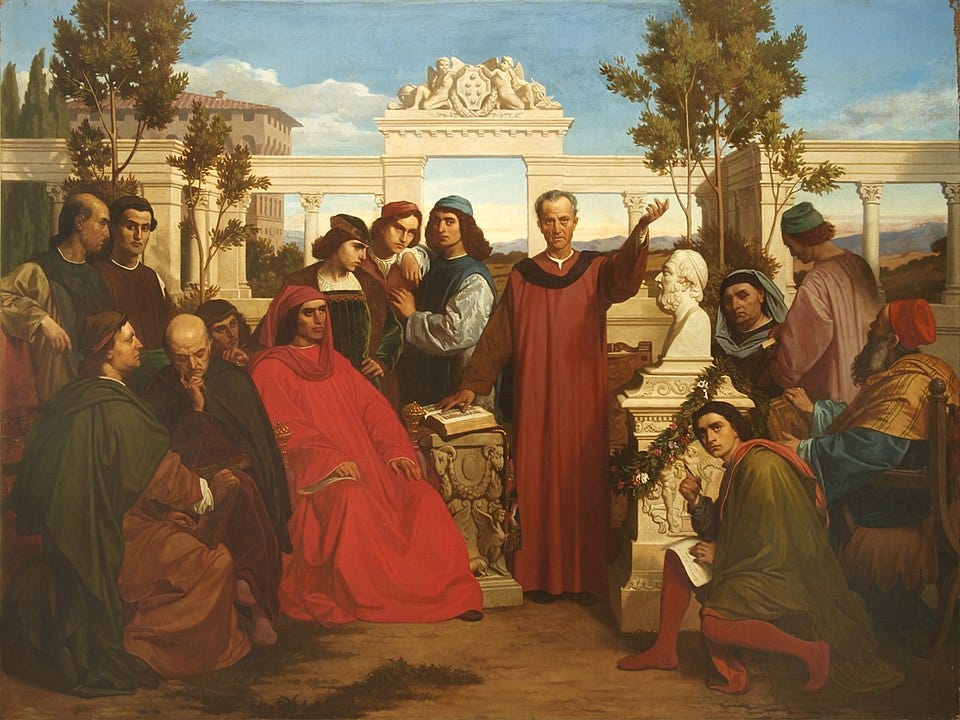
The Birthday of Plato Celebrated in the Villa di Careggi by Lorenzo the Magnificent, 1862, Wikimedia

Is it any wonder why Plato is a great guide and inspiration for us as we exercise our body, mind and spirit?
The question Plato inspires us to ask is: How can we become beautiful souls, in strong bodies, struggling to be Good?
In the next lesson Socrates teaches us about the importance of the most articulated value in ancient Greek culture