


We must not train the body while neglecting the soul. Rather, just as the body is strengthened through exercise, so too must the soul be hardened through trials, discipline, and study. - Plato, Republic 410b
Corporate Athlete 1.0 - The Modern Corporate Athlete Skillfully Manages Energy
“Corporate Athlete” is a term I use because to perform at high levels, a corporate executive needs as much stamina as a professional athlete needs in competitive sports. Consider the demands that today’s business climate makes on Corporate Athletes: they must perform at highly competitive levels under intense pressure for ten or more hours a day, often six days a week. They are expected to continue this extraordinary output over a career span of four decades.” - Jack Groppel 1
In the early part of this century the concept of the ‘’Corporate Athlete’’ entered the modern personal development lexicon. Created by Dr. Jack Groppel, an exercise physiologist and Dr. Jim Loehr, a sports psychologist, the two partnered to use sports science to help their business clients. They called their clients, business executives and professional managers, Corporate Athletes.
Their premise is that business leaders can achieve sustained high performance, in an environment of rapid change and increasing pressure, by applying lessons from professional athletes. The creators of the Corporate Athlete program believe that the ‘’non-athlete’’ business leader and busy professional, have a more demanding job than an elite-level athlete.
Dr Groppel and Dr. Loehr taught the importance of skillfully managing energy: ‘’the fundamental currency of life, both personal and professional.’’ One of the most important ideas the Corporate Athlete approach brought to our understanding of performance is that the human body is ‘’performance-relevant.’’ And to improve your performance you have to understand how your body produces, manages and renews energy. This requires training like an elite athlete.
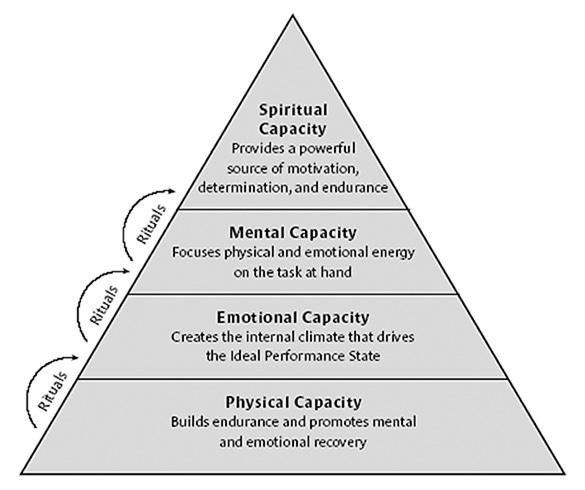
According to the Corporate Athlete approach, the best model to understand high performance is seeing a human as an integrated and multi-dimensional energy system. The foundation of energy management is physical energy. There’s a rhythmic flow (“oscillation”) of energy expenditure: stressing our body means energy out and recovery results in energy in. Without regular renewal, our ability to effectively increase energy is at risk.
This holistic approach to energy management is depicted as an energy pyramid with the physical dimension as the foundation and emotional, mental and spiritual levels ascending in significance.
A successful approach to sustained high performance, we have found, must pull together all of these elements and consider the person as a whole. Thus, our integrated theory of performance management addresses the body, the emotions, the mind, and the spirit. We call this hierarchy the performance pyramid. Each of its levels profoundly influences the others, and failure to address any one of them compromises performance. 2
The concept of a Corporate Athlete is an effective idea to help us better cope with the increasing modern demands on our work-life balance. As the authors of the concept explained, the principles that govern an athletes’ success apply to corporate employees’ success: “Applying sport science research to the world of business serves another purpose. Corporate employees will see that the principles that govern an athlete’s success are rather analogous to those that govern their success.” 3
But the Corporate Athlete model also has flaws that impact our holistic growth.
Corporate Athlete 2.0 - The Ancient Athlete Trains and Cultivates Virtue
“If you want to progress, do not say you are a philosopher—show it through your actions. A true philosopher does not spend his days discussing what virtue is, but rather, he exercises virtue. Do you wish to be patient? Then train yourself in endurance. Do you wish to be free? Then train yourself to let go of what is beyond your control. Do you wish to be fearless? Then meet hardship with courage. Just as an athlete does not become strong by merely listening to his trainer, but by lifting weights and running, so too must you train daily in the practices of philosophy. Otherwise, you are not a philosopher—you are only a speaker of words.” — Epictetus, Discourses 2.19
Is energy management and engagement enough for a leader’s high performance?
There are definitely benefits in imitating the best practices of sports training and learning the athlete’s energy management skills. We modern achievers owe a debt to Dr. Loehr and Dr. Groppel for ensuring that energy management is a consideration in all our training programs.
But is this enough for the foundation of a leader’s holistic performance program?
Their answer is we modern day business leaders need to understand how to skillfully manage energy: ‘’the fundamental currency of life, both personal and professional.’’ 4
The Corporate Athlete’s strength is actually its major weakness: the program’s focus is solely physical. This is a reflection of the creators’ background in sports science. This program has done a good job of addressing the weakness of most performance programs which focus mainly on cognitive capacity. We learn to apply ‘’energy management technology” to improve performance and engagement.
The performance pyramid is a good first step to bring a holistic approach to training. It tries to differentiate from a pure cognitive perspective. But the Corporate Athlete program goes too much in the opposite direction and focuses primarily on the physical. As a result, this over-reliance of looking at high performance as a physical activity misses several important domains of a leader’s growth and development.
Here are important areas not addressed in the Corporate Athlete program:
Character and virtue. The foundation of all good leadership is character and virtue, what the Greeks called arete. Virtue here means habits of human excellence. Character is paradoxically the foundation of, and a by-product from, successfully achieving a difficult objective. No elements of timeless virtues like courage, wisdom or self-control are addressed.
Religion and transcendence. Here is how the spiritual dimension is addressed in the Harvard Business Review article, The Making of a Corporate Athlete:
“Most executives are wary of addressing the spiritual level of the performance pyramid in business settings, and understandably so. The word “spiritual” prompts conflicting emotions and doesn’t seem immediately relevant to high performance. So let’s be clear: by spiritual capacity, we simply mean the energy that is unleashed by tapping into one’s deepest values and defining a strong sense of purpose.” 5
Look at the acknowledgement to being wary of addressing the spiritual level. They generalize spirituality to mean “values” and ‘’purpose.’’ Those are very important characteristics but it’s not spirituality. Missing is any acknowledgement of God, transcendence or any elements of authentic religion.
Struggle and competition. Actively achieving the standards of a Corporate Athlete requires struggle. To improve our physical capacities requires strenuous and focused effort. We’ll need to compete with others and ourselves to reach our ideal performance state. For experts who trained competitive athletes for over two decades, glaringly missing is any reference to a notion of competition or struggle.
Integrative health science beyond exercise. The effective application of energy management skills requires more than just exercise and rest. It requires an integrated approach to health, combining ancient wisdom and modern practice. Yes, the Corporate Athletes program writes about diet, sleep and hydration. But their health advice is quite dated. Missing is ancient wisdom like fasting or modern practices like labs. Arguably, the most essential tool in assessing how healthy one is and how best to achieve optimal function is to obtain comprehensive laboratory studies or blood work. None of these points are included.
We are thankful for the insights of the Corporate Athlete approach but recognize its shortcomings. To get a better understanding of the ideal of striving for high performance we suggest going back in time to the original athletes of ancient Greece.
The way forward is through the past.
There is a much deeper history and tradition of the athlete than just the modern professional or corporate athlete. The athlete has a central role in the evolution of excellence from Homer to Christ.
The ancient athlete way provides an evolutionary path for growth embedded in the roles and identities of classical Greeks and the inheritors of Hellenic wisdom. From Homer’s warriors to the Olympic contestants, from the citizens of the polis to the Hellenic philosophers and lovers of wisdom to the spiritual struggle of early Christians, the athlete was an identity of excellence and healthy struggle for the prize of virtue.
Let’s explore how the athletic identities and archetypes of Greek culture evolved and provide us with role models in our quest for excellence and personal transformation.
Olympic-Athlete. Turning Pro: The origin of high-performance competition. High performance culture has a start date, 776 B.C. This is when the first Olympic games were founded. It marked the start of a competitive tradition that would last over 1,000 years. Olympic athletes were professionals who trained over 10 months to prepare for the games. The concept of “amateur athletics” is a 19th-century development that would have been foreign to the ancient Greeks. For them, the pursuit of valuable prizes was an integral part of being an athlete.
“I cannot, just by telling you about it, convince you of the pleasure of what happens at such a festival as well as you would learn for yourself, sitting in the middle of the crowd, watching the arete of men and physical beauty, amazing conditioning and great skill and irresistible force and daring and pride and unbeatable determination and indescribable passion for victory. I know that you would not stop praising and cheering and applauding.’’ – Lucian, Anarcharis 12 (translation Miller)

Greek vase with boxers and trainer. 510–500 BC. Wikimedia

Warrior-Athlete. Homer’s heroes: soldiers in war, athletes in peace. Homer’s athletes were both warriors and athletes. Both the Iliad and the Odyssey are filled with stories on athletic competition and references to athletes. Homer’s works not only describe athletic competitions but also use athletic prowess as a means to demonstrate virtue and heroism.
Achilles, the greatest Greek warrior in the Iliad, is frequently described in athletic terms. He is often called “swift-footed Achilles’’ with a good physique who organizes and conducts funeral games for Patroclus, showcasing his leadership in athletic contexts. Odysseus is more of a cunning athlete. When challenged and called out that he is not an athlete, Odysseus surpasses local athletes in the discus. And he secures a draw in wrestling the mighty Ajax in Patroclus’ funeral games.
Mythic-Athlete: Hercules, strength in suffering for greatness, physically and morally. Hercules was not only an athletic cultural hero associated with the Olympic Games but also a moral exemplar through his famous labors.
As an athletic hero, Hercules is credited with founding the Olympic Games in honor of his father Zeus. Hercules became known as the god of the gymnasium, athletes, strength, and heroes. Beyond his athletic achievements, Hercules’ story embodies a moral journey of virtue and vice. His famous Twelve Labors serve as a metaphor for overcoming personal challenges and striving for greatness. These labors were not just feats of strength, but tests of character, ingenuity, perseverance and suffering.
Citizen-Athlete: People of the gymnasium. We’ve seen in lesson 4 that the Greeks were considered ‘’people of the gymnasium.’’ In their contact with other Mediterranean cultures, such as the Jews and the Egyptians, the centrality and importance of the gymnasium set apart the Greeks. All citizens, from youth to adults, trained in the gymnasium.
Philosopher-Athlete: Beautiful souls, in strong bodies training to be Good. We’ve seen in lesson 3 that physical exercise, gymnastiki was the foundation of Plato’s program for leadership development. It may seem strange to us with our modern eyes, but Plato’s school, the original Academy, was a gymnasium. Plato was a former athlete and his philosophers embraced athletic training.
Christian-Athlete: Struggling for the prize of salvation. St. Paul uses athletes from the Greek athletic festivals as examples of how we are to live as Christians. As we’ve seen in lesson 7, athletic training and competition are used to highlight the importance of self-discipline, focus, and endurance in the Christian life.
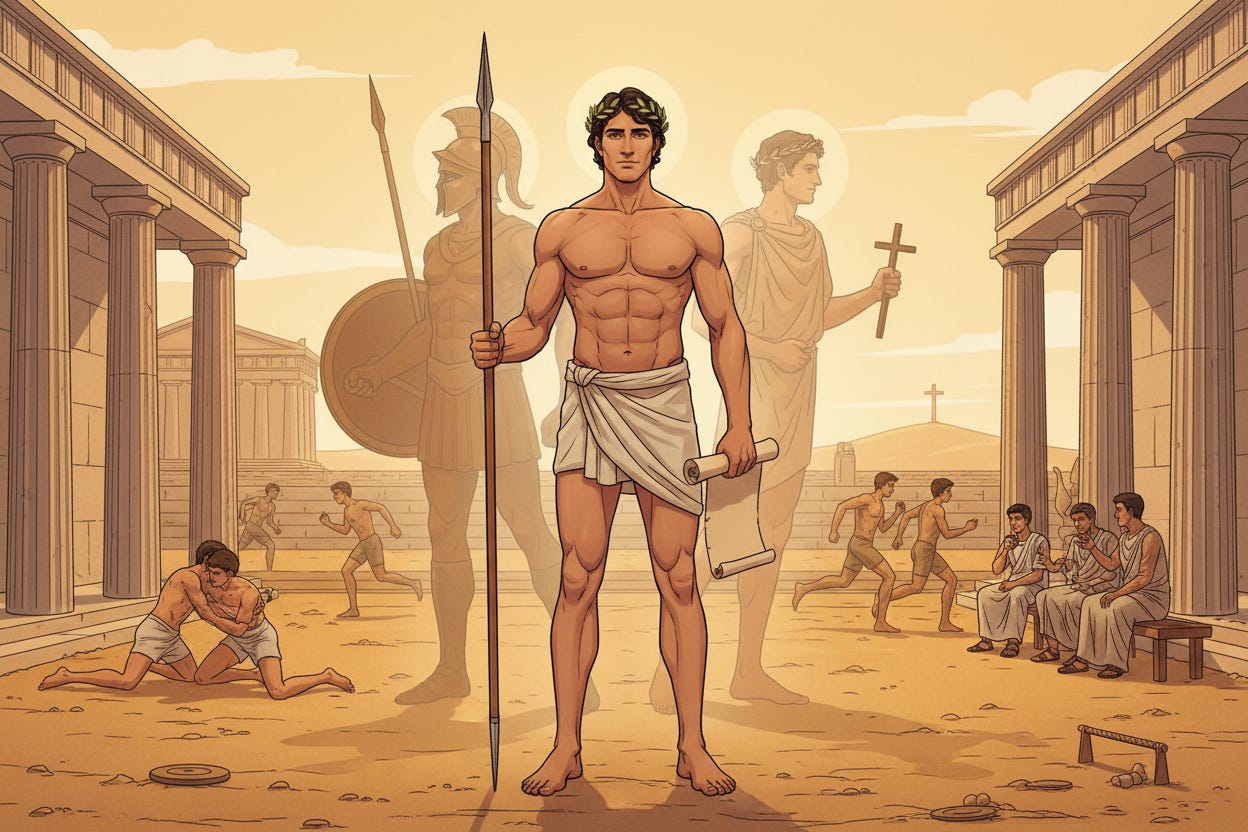
All these great athletes of the Hellenic world didn’t train solely for energy, as the modern corporate athlete does. The ancient athlete trains for virtue, arete - human excellence - physically, morally and spiritually.
We look to the great Plato for a holistic approach to working out. We embrace his wisdom when he argues that the soul and the body must be exercised to achieve strength and mastery
In our final lesson we will show you how to combine the Corporate Athlete training with the Ancient Athlete ethos for a truly integrated program of body, mind and soul.
Notes
The Corporate Athlete, J. Groppel – 2000, p.2
The Making of a Corporate Athlete , Harvard Business Review article, J. Loehr and Tony Schwartz, 2001
The Corporate Athlete Advantage, J Loehr and J Groppel – 2008
The Corporate Athlete Advantage, J Loehr and J Groppel – 2008, p.3
The Making of a Corporate Athlete Harvard Business Review article, J. Loehr and Tony Schwartz, 2001