

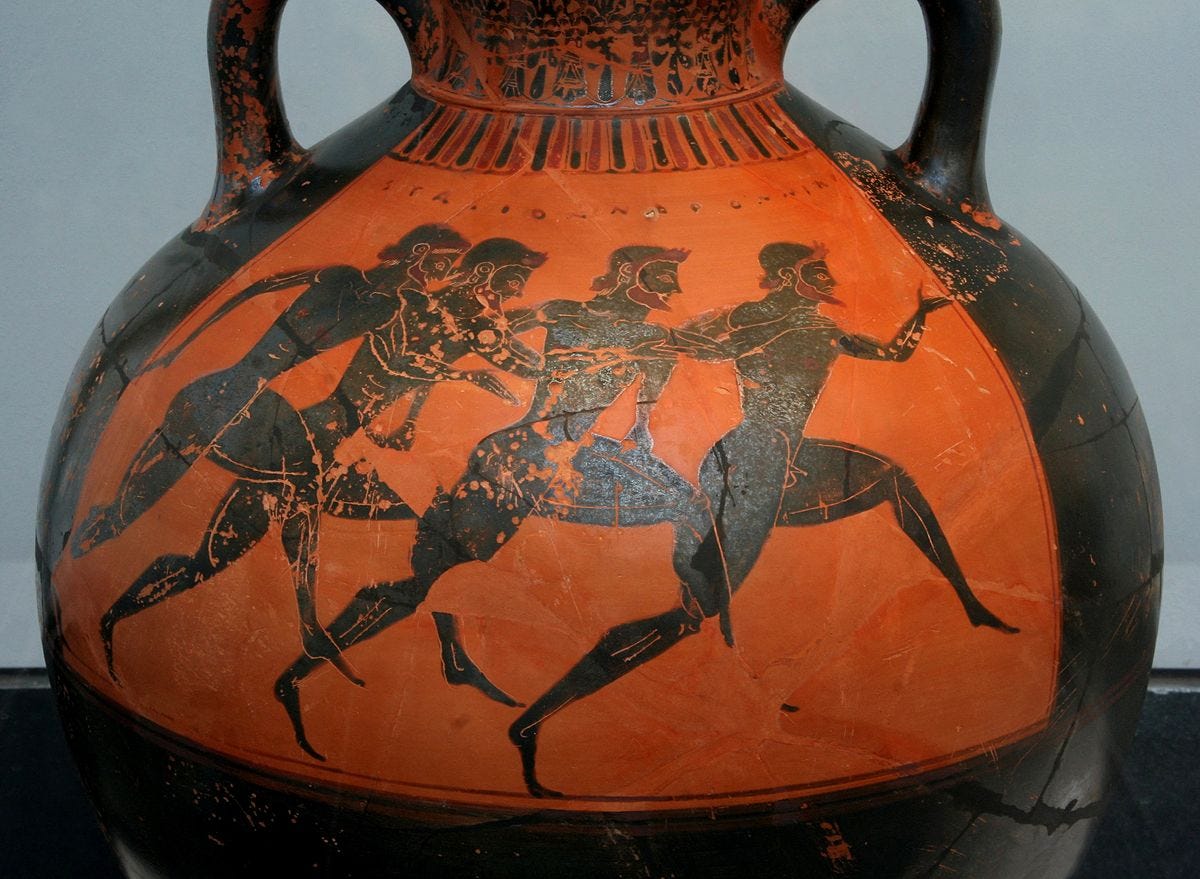
Greek vase with runners at the panathenaic games, ca. 530 BC, Wikimedia

Difficulties show a person who they truly are. So when hardship comes, remember that the contest has been given to you as an opportunity. The Olympic Games are not won by the strongest or most beautiful, but by those who train, struggle, and endure. Say to yourself, ‘I will train my will, my endurance, my self-control, just as an athlete trains his body.’ — Epictetus, Discourses 1.24.1
The Ancient Greek Athlete as a Unique Way of Life
‘’As in the very earliest times, athletics was still one of the primary distinguishing marks of the Greek way of life as against that of the barbarians.’’ - H.I. Marrou 1
We’ve seen in lesson 5 that the history of ancient Greek education can be summarized as the transition from a noble warrior to a scribe culture; from Homer to the Bible. Underlying this education and culture of excellence was the role of the athlete. As the late French classicist H.I. Marrou commented above, athletics was a way of life for the ancient Greeks and this distinguished them from non-Greeks.
Athletics wasn’t just a pastime for the Greeks but a way of life. For the ancient Greeks physical education and athletics were the foundation of their culture and the basis of their education. From Homeric times to the golden age of Athens (4th Century BC) to after the conquest of Rome, “physical training remained an essential part of the process of initiation into civilized life – that is to say, of education. ‘’
Modern imitation of athletes for high performance is quite common now. We strive to manage our energy, train our bodies, lift heavy, run fast, get in the ‘’zone’’ or flow, eat clean and nutritious, take health supplements and develop a resilient mindset. These are all important health ideas but incomplete for our holistic growth.
Our approach is that we can learn more from, and be inspired by, the ancient athletes as a foundation for our modern high performance. Whereas modern athletes can teach us primarily the benefits of the body – physical – the ancient Greek athlete inspired our bodies, minds (our intellects) and our soul.
What can the ancient athletes teach us that the modern athlete cannot?
A lot.
Studying the world of the ancient athlete offers a radical approach to our growth. Radical, not as extreme but in going to the roots – the actual definition of radical. The roots here is that of western civilization and culture. The focus is not new and different but old and proven.
Long before the golden age of ancient Greece, the fifth century BC, athletic training had been an integral part of Greek education (paideia) as a means to build moral character and virtue (arete). “Given athleticism’s deep historical links with arete, it is likely that gymnastic education was intended in part to develop – or at least reveal – virtue,’’ writes Heather Reid, professor of philosophy and a former elite cyclist. 2
The ancient athlete becomes a framework and metaphor for our personal growth. We learn about beauty, virtue and strength: training to have beautiful souls in strong bodies struggling to be good. The training of the athlete becomes a contest of virtue. We compete – with others and ourselves – not for the scoreboard but to become better. We strive for human excellence – virtue – moral, intellectual, spiritual and physical.
It’s our belief that if you want a truly holistic and complete view of the pursuit of high performance you can do no better than studying the original culture of excellence. To go forward in your performance let’s go back in time to the world of the first athletes of ancient Greece.
The True Meaning of an Athlete: to Struggle & Suffer in a Contest for the Prize
What is an athlete?
We’ve declared that the ancient athlete is a way of life we need to embrace for our personal growth, but what does the word actually mean?
We shouldn’t be surprised that athlete is a Greek word. Like gymnasium, gymnastics, Olympics, hygiene, diet and calisthenics, athlete is another word originating from the deep Greek history of physical excellence and culture.
A brief look into etymology – the history of words – provides surprising revelations about the original meaning of an athlete. This reveals not only the unique perspective the ancient Greeks had on these original athletes but helps us embrace and embody the proper identity for our growth.
The English word athlete is the romanization of the ancient Greek word athlētēs (in Greek άθλητὴς). Like most of the Greek words in our modern vernacular, athlete is the product of rendering non-Latin words into a Latin style. As the ancient Romans conquered Greece, they integrated Greek culture and their vocabulary. Our modern English language has many of these Latinized Greek words and athlete is one example.
Today’s dictionaries will define an athlete in similar ways: a participant in a group of sporting activities or a person trained in these sports, exercises or games. That seems to coincide with our modern understanding of an athlete. But it’s not what the Greeks meant in their original definition. We should start by taking guidance from the original creators of the word. That’s where etymology helps.
The ancient Greek athletes idolized the divine hero Hercules (romanized from the Greek Herakles). Hercules was arguably the greatest of Greek heroes. The Greeks knew him from many adventures, especially his labors. These were difficult feats or challenges he was forced to do as penance for upsetting the gods. If he succeeded he would be granted immortality by the gods of Olympus. British classicist Nigel Spivey explains how trying to be like Hercules reveals how ancient Greek athletes thought of themselves:
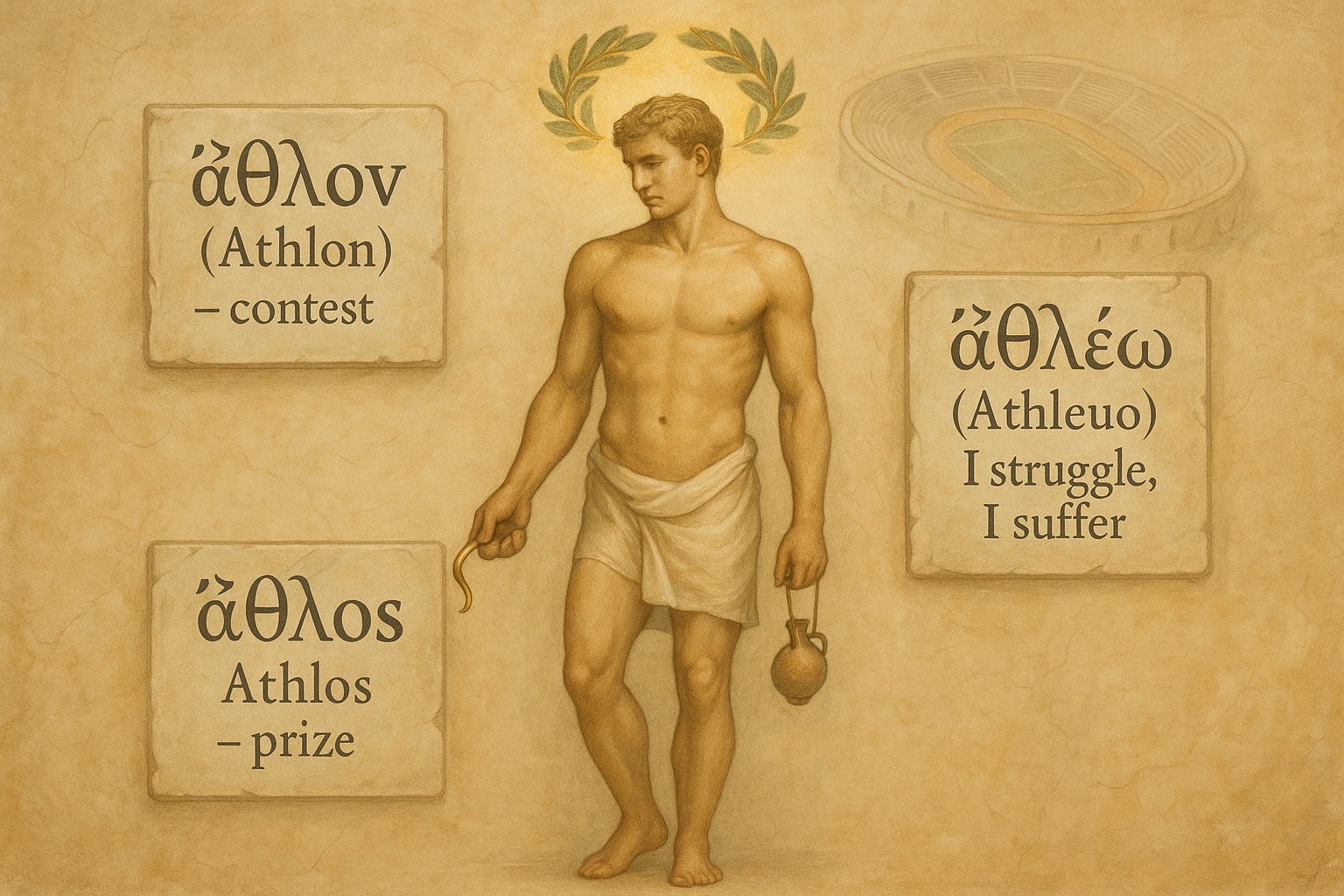
But there was a sense in which every Classical male athlete strove to be a second Herakles, undertaking to train and compete as if facing up to the trials of nightmarish persecution by one monster after another. Greek parlance acknowledged this by letting the noun athlon (or athlos) connote any sort of fight or contest, with the verb athleuo meaning not only ‘I take part in a contest’ but ‘I suffer’. On the positive side, the same cognate term implies that such suffering is not for nothing: with athlos also meaning ‘prize’, the expectation of reward is firmly attached. So Herakles, at the end of his hard-fought and heavily afflicted life, gained the greatest prize of all – elevation to immortal rank, joining the Olympian gods. 3
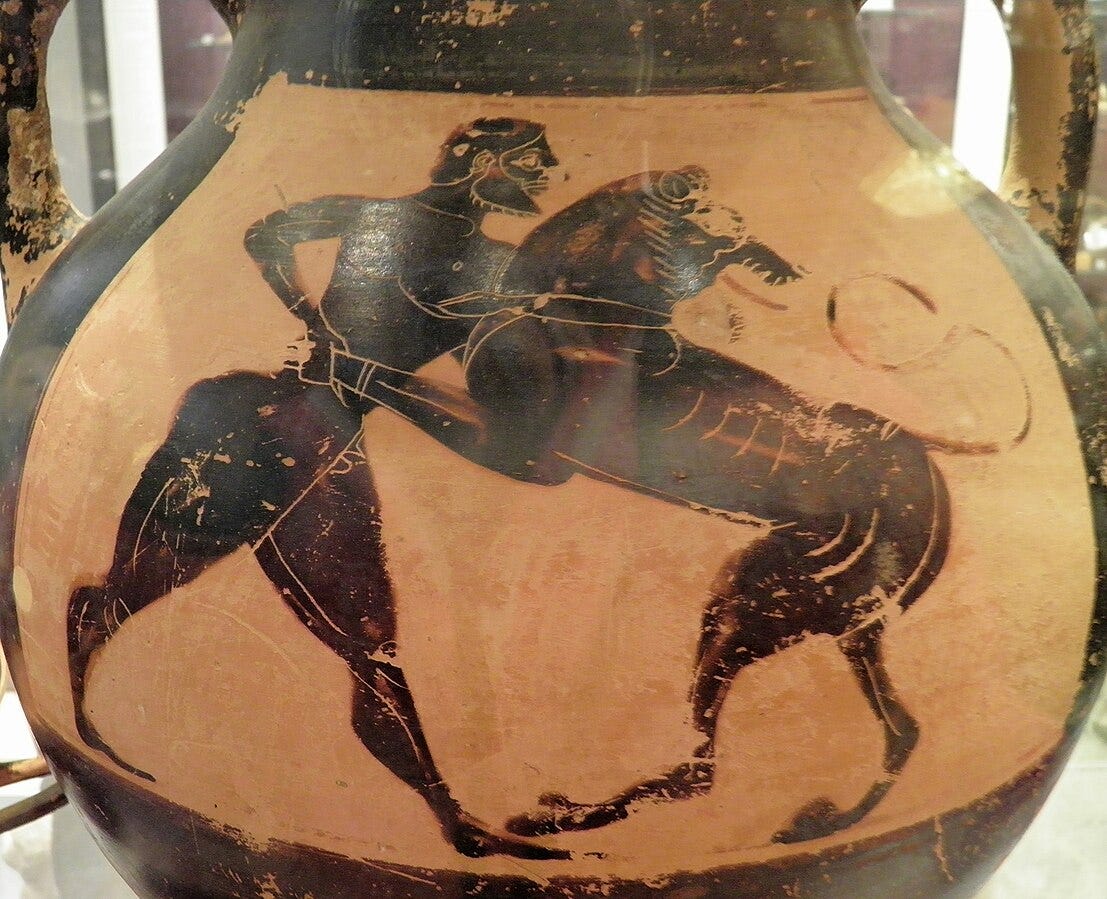
Herakles wrestling with the Nemean lion, 6th century BC, Ashmolean Museum, Wikimedia
.jpg)
From the ancient Greek we find three different words which combined created the original meaning of athlete.
Athlon: this meant any sort of contest
Athleuo: this meant not only “I take part in a contest” but also “I suffer,” “I struggle”
Athlos: this suffering was not for nothing. This means “prize,” emphasizing the importance of the expectation of reward.
We can combine these concepts and create a more accurate meaning of athlete:
to suffer and struggle in a contest for the prize.
This spirit of struggle, contest and prize helps inform and shape our attitude and ethos of training.
Our ultimate goal is to combine the ancient wisdom and modern practices of athletes to exercise our bodies, minds and souls.
In the next lesson we will look at the benefits of the modern athletic training programs, like the Corporate Athlete and why the Ancient Athlete is superior.
Notes
H.I. Marrou, A history of education in antiquity. Translated by George Lamb. Madison, Wisconsin: University of Wisconsin Press. p. 116
Sport, Ethics and Philosophy, Volume 4, 2010 - Issue 2: Athletics and Philosophy in Ancient Greece and Rome: Contests of Virtue
Nigel Spivey, The Ancient Olympics (pp. 75-76). Oxford University Press. Kindle Edition.