

Welcome back to Plato’s Workout newsletter: a weekly meditation on the philosophy of human excellence. My mission is to recover the lessons of virtue from the Western Tradition, one Great Book at a time. We’ve had 103 recent subscribers eager to Read deeply, Train wisely and Live virtuously. If someone forwarded this to you, subscribe here:.
The biggest trap in classical reading today is becoming a genre specialist rather than a disciplined generalist.
Everywhere online, readers retreat into comfortable silos:
The Fiction Devotee tackling Tolstoy, Woolf, Conrad and Austen.
The Modern Stoic re-reading Seneca, Marcus Aurelius, and Epictetus on repeat.
The History Buff binging biographies of Caesar, Alexander, and Napoleon.
This trends shows itself in online literature book clubs, dedicated Stoic podcasts and You Tube channels focused on biographies of history’s great men
It is great to see minds returning to the Western canon, but isolating these genres dulls their power. Classical wisdom was never meant to be read in isolation.
Reading the Great Books in chronological order has taught me a fundamental truth: Epic poetry, history, and philosophy are not distinct hobbies; they are three muscle groups in the same intellectual workout.
Let’s look at the ancient Greeks. Here is my reading list as I read the Great Books in chronological order, starting with Homer.
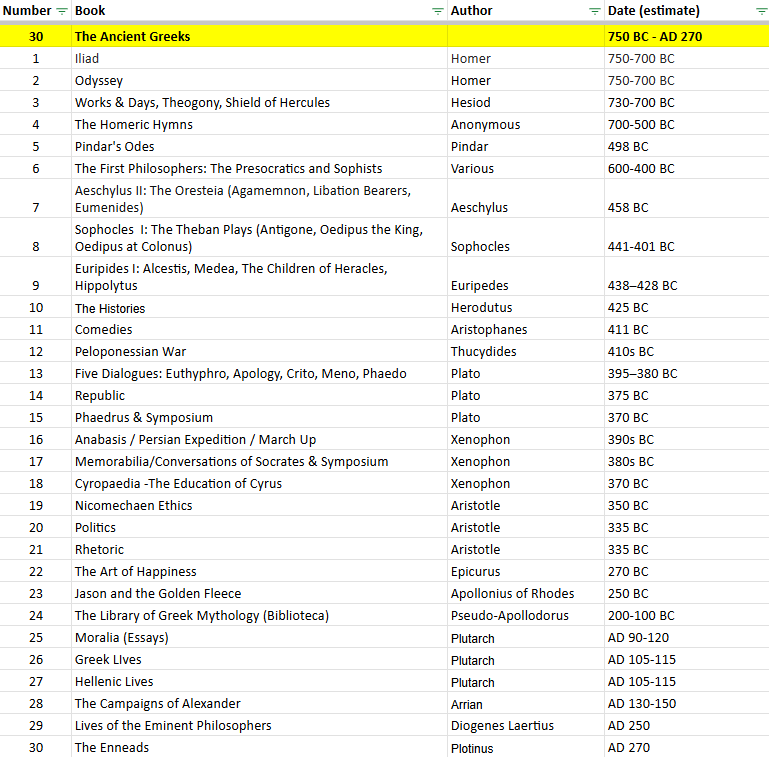
What do you notice when you look at this list of 30 ancient Greek classics? It’s not made up of one genre. In fact, there are 3 main, broad categories of reading, with associated sub genres.
Literature: The list begins with Homer’s epic poetry in The Iliad and The Odyssey. Later on we see Pindar’s lyric poetry. And beginning with Aeschylus, and continuing with Sophocles and Euripides, we see the creation of Tragedy.
History. History begins with Herodotus, who invented the word meaning ‘inquiry’ or ‘investigation. Later in the 5th Century BC Thucydides chronicled the 27 year Peloponnesian war between Athens and Sparta. By the end of the list, when the Greeks were part of the Roman empire, Plutarch invented biography.
Philosophy. Philosophy, literally the love of wisdom, was defined by Socrates. Before him we have the Pre-Socratics who focused on natural phenomena and the meaning of the cosmos. Later Plato introduces us to Socrates in his dialogues. And Plato’s student Aristotle broadens philosophy further, systematizing everything from logic and ethics to biology, rhetoric, and politics.
Think of a thinker like Xenophon, who refused modern departmental boundaries entirely. He was a student of Socrates, a general who led Greek mercenary troops in Persia and later a historian. Xenophon gave us hard military history in Anabasis, foundational philosophy in Memorabilia (written about his experience with Socrates), and early narrative romance in Cyropaedia, The Education of Cyrus.
All three of these categories play an indispensable role in our intellectual growth:
Literature forms our moral imagination and maps the turbulent depths of the human soul.
History provides the empirical laboratory of real human action, power, and statecraft.
Philosophy supplies the conceptual framework—the intellectual discipline—to judge both, teaching us how to reason, what to value, and how to live.
Neglect any one of them, and your reading workout becomes dangerously lopsided. Literature without history drifts into ungrounded aestheticism. History without philosophy degenerates into trivia and cynicism. And philosophy without literature loses its grip on raw human feeling.
To build a genuinely robust mind, you cannot afford to skip any part of the classical canon
C.S. Lewis famously advised alternating between old and new books.
“It is a good rule, after reading a new book, never to allow yourself another new one till you have read an old one in between.
My rule is simpler: cross-train your reading.
Before you dive into another modern novel, open a dialogue of Plato. Before picking up another biography of Rome’s conquerors, read an epic poem.
Specialization breeds blind spots; intellectual cross-training builds real perspective.