

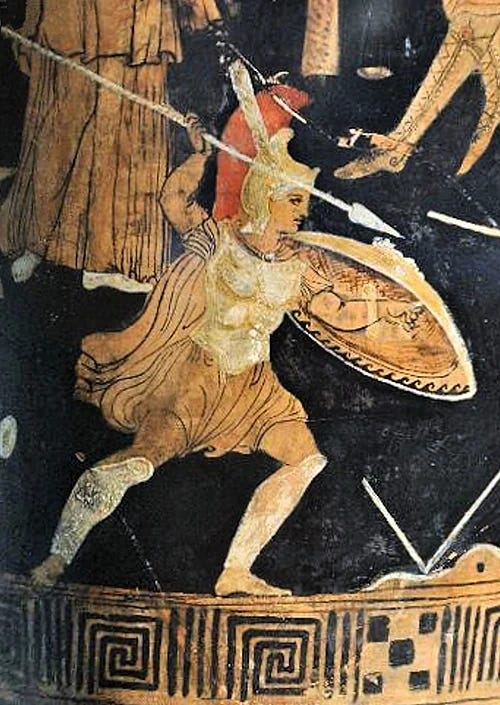
Source: Achilles fighting against Memnon, Leiden Rijksmuseum voor Oudheden, Public Domain
3 Lessons from Achilles, the Original Homeric Hero
There has been a lot of controversy recently about Christopher Nolan’s upcoming version of The Odyssey. Much of it has been about the ‘’rumored’’ actor playing Achilles and whether they look like Brad Pitt’s portrayal from the movie Troy (2004).
Achilles appears only briefly in The Odyssey. His most famous line is one of remorse and regret. He seems to be rejecting his heroic glory in Hades:
I would rather follow the plow as thrall to another man, one with no land allotted him and not much to live on, than be king over all the perished dead.
- Achilles, The Odyssey 11.488–491 (Lattimore)
It’s a small but memorable role sharing the real cost of glory. Achilles would rather be alive in humble service on a farm versus ruling in Hades.
But to get the complete and full picture of Achilles you need to engage and read The Iliad.
Welcome to Plato’s Workout
Plato’s Workout is a weekly meditation on the philosophy of human excellence.
Each week, you’ll find:
I. The Weekly Essay
Lessons in virtue, leadership, and life drawn from the great books of the Western tradition.
II. The Wisdom Practice
Aphorisms, maxims, and passages to reflect on and carry into your week.
III. Classics for the Digital Age
A curated selection of classical insights, quotations, and reflections discovered in today’s online conversations and brought together for thoughtful reflection.
Read deeply. Train wisely. Live virtuously.
Here are 3 lessons on leadership and life from Homer’s first hero Achilles and the men he led.
1. The Consequences of Uncontrolled Rage - The Anger of Achilles
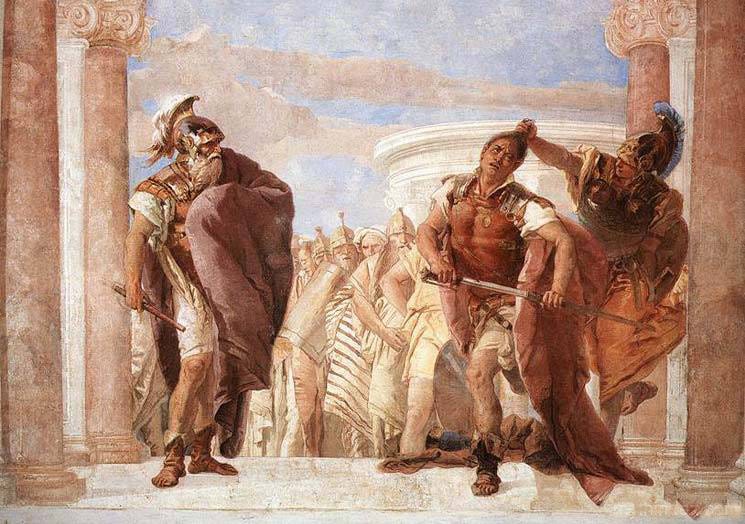
Source: The Rage of Achilles, by Giovanni Battista Tiepolo (1696-1770), Public Domain
Sing, goddess, the anger of Peleus’ son Achilleus [Achilles]
and its devastation, which put pains thousandfold upon the Achaians [Greeks],
hurled in their multitudes to the house of Hades strong souls
of heroes, but gave their bodies to be the delicate feasting
of dogs, of all birds, and the will of Zeus was accomplished
since that time when first there stood in division of conflict
Atreus’ son the lord of men and brilliant Achilleus.
- The Iliad, Book 1, 1-9 (all translations from Lattimore)
The Iliad begins with the anger (or rage) of Achilles. Achilles’s anger - its cause, the course it takes, and terrible consequences - is the theme of the poem. In fact, the Iliad can be considered a meditation on anger. How Achilles tries to manage it, how others try to restrain or inflame his anger, drives the story and plot forward.
The opening book of the Iliad is educational in a surprising manner. Our first lesson is not aspirational, to emulate these great heroes, but negative, in terms of avoiding their great vices.
We see the detrimental effect of a lack of self-control. I always likened Achilles’ behavior to a top, star athlete of a sports team who doesn’t get his way, and sits out a number of important games. This elite, franchise athlete threatens to even sit out the rest of the season, putting his own honor ahead of his team’s interests.
We witness a range of emotional reactions from ‘’the best of the Achaeans:’’ the best fighter of the Greeks. In addition to Achilles’ rage and strong feeling of dishonor we see a crying champion.
This surprising reaction will startle a first time reader. Like us, Achilles is flawed. Book 1 doesn’t end with contrition or remorse. In fact, we close out the chapter by seeing Achilles ask his immortal mother to help out the Trojans, the enemy. Achilles not only sits out the competition but is plotting for the opponent to wi.
2. Glory is Earned by Being in the Front Line - “Where Men Win Glory”
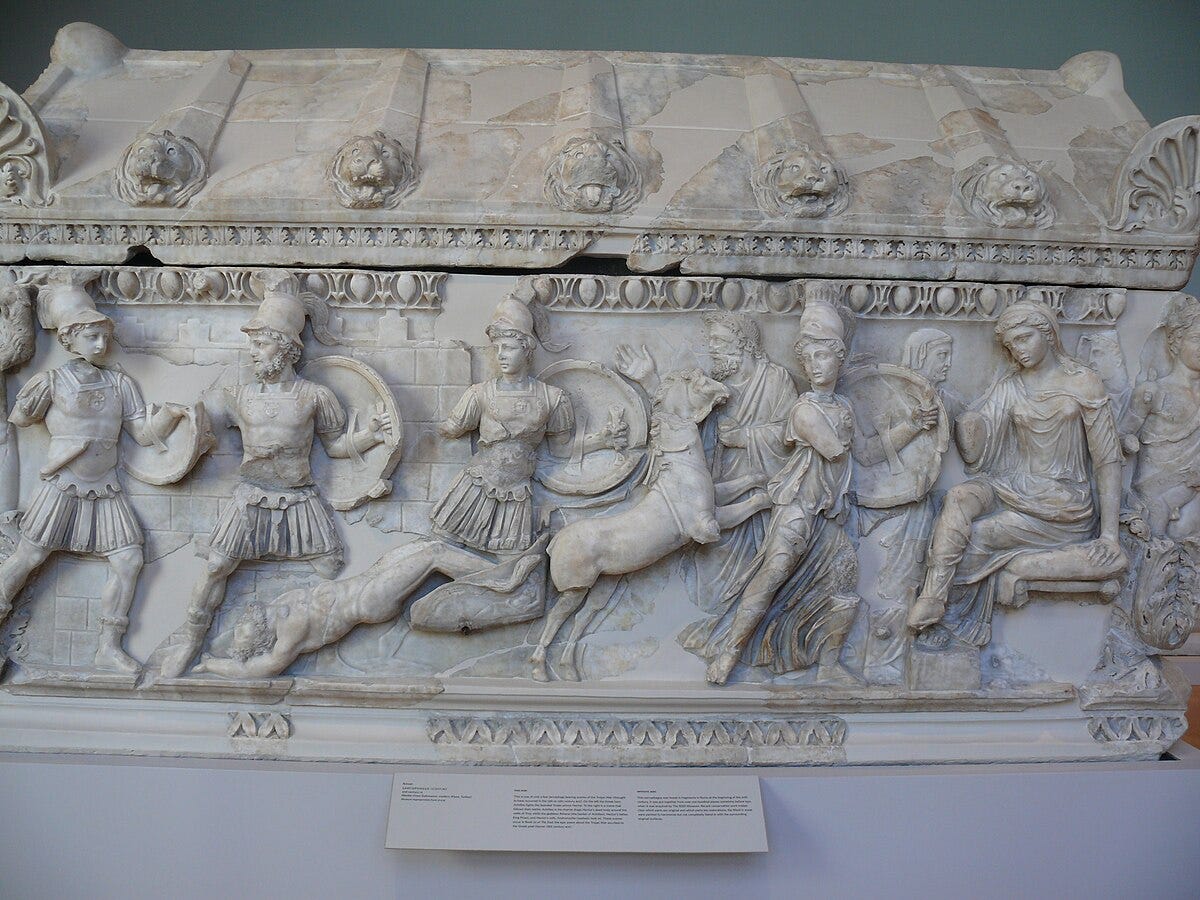
Source: Sarcophagus with scenes of the Trojan War, in the Rhode Island School of Design Museum, Public Domain
Now Glaukos, sprung of Hippolochos, and the son of Tydeus
came together in the space between the two armies, battle-bent.
Now as these advancing came to one place and encountered,
first to speak was Diomedes of the great war cry:
“Who among mortal men are you, good friend? Since never
before have I seen you in the fighting where men win glory,
yet now you have come striding far out in front of all others
in your great heart, who have dared stand up to my spear far-shadowing.
Yet unhappy are those whose sons match warcraft against me.
- Diomedes to Glaukos, Book 6, 120–128 (my emphasis)
The phrase,‘ ’where men win glory,’’ is used repeatedly in the Iliad. The word for glory (kleos) has also been translated as fame, in other editions. Although the opponents have parted on friendly terms, this space ‘’between two armies’’’ is where the fighting takes place throughout the Iliad.
A few books later, Sarpedon—Glaukos’ king and Zeus’ mortal son—articulates the classic Greek ethic of earned glory.
“Glaukos, why is it you and I are honored before others with pride of place, the choice meats and the filled wine cups in Lykia, and all men look on us as if we were immortals, and we are appointed a great piece of and by the banks of Xanthos, good land, orchard and vineyard, and ploughland for the planting of wheat? Therefore it is our duty in the forefront of the Lykians to take our stand, and bear our part of the blazing of battle, so that a man of the close-armored Lykians may say of us:
‘Indeed, these are no ignoble men who are lords of Lykia, these kings of ours, who feed upon the fat sheep appointed and drink the exquisite sweet wine, since indeed there is strength of valor in them, since they fight in the forefront of the Lykians. - Book 12, 309-322
And the section ends with a reflection on what would happen if they escaped this battle and didn’t do their duty.
Man, supposing you and I, escaping this battle, would be able to live on forever, ageless, immortal, so neither would I myself go on fighting in the foremost nor would I urge you into the fighting where men win glory. But now, seeing that the spirits of death stand close about us in their thousands, no man can turn aside nor escape them, let us go on and win glory for ourselves, or yield it to others.” - - Book 12, 323 -328
Homer teaches us that if we want to be elite and be a leader we have to earn our glory. How do we do that? By being in the front line, doing our duty, leading by example and sharing the risk and burdens with our followers.
3. The Transformation of Achilles — From Rage to Humility
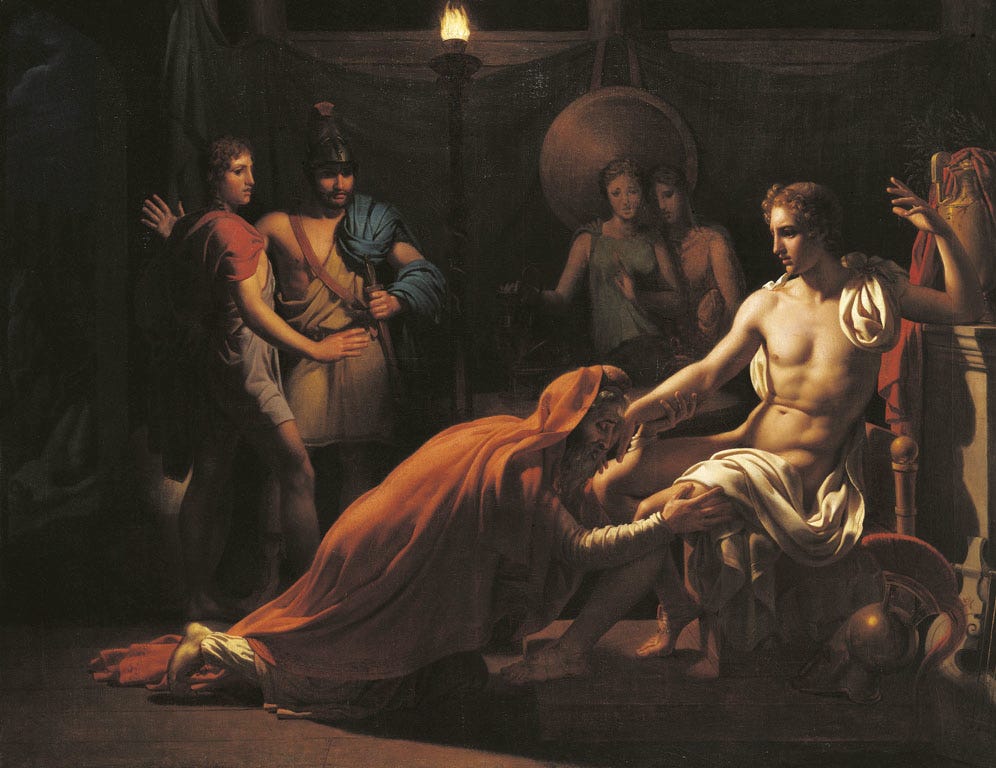
Source: Priam at the feet of Achilles, Jérôme-Martin Langlois, Priam aux pieds d'Achille, 1809, Paris, Ecole Nationale Supérieure des Beaux-Arts. Public Domain
So he spoke, and stirred in the other a passion of grieving for his own father. He took the old man’s hand and pushed him gently away, and the two remembered, as Priam sat huddled
at the feet of Achilleus and wept close for manslaughtering Hektor and Achilleus wept now for his own father, now again for Patroklos. The sound of their mourning moved in the house. - Book 24, 507-514 (my emphasis)
The Iliad begins with the rage of Achilles; it ends with the tears of Achilles. The arc of the poem is the arc of this man’s soul. By Book 24, after all the broken oaths, ruined bodies, and funeral fires, Homer brings us into the quiet interior of Achilles’ transformation. The “best of the Achaeans” is no longer simply the man “where men win glory,” but the man who has learned how to weep, to pity, and to honor an enemy as a fellow mortal.
Book 24 gives us the Iliad’s most astonishing scene: Achilles and Priam, killer and victim’s father, alone together in a tent at night, weeping. This is not the Achilles we met in Book 1, threatening to kill his own commander. This is not the Achilles of Book 22, dragging Hector’s corpse behind his chariot in savage triumph. Something has changed.
The greatest warrior of the Greeks moves from uncontrolled wrath to something far rarer in epic literature: genuine compassion for an enemy. The poem opens with Achilles dishonoring a priest and a king; it closes with Achilles honoring a father and a corpse.
For us, the lesson is clear: The greatest leaders are those who can be transformed by suffering, who can extend mercy without losing strength, and who remember that all of us—friend and foe alike—are bound by the same mortal fate.
II. The Wisdom Practice
Pain and suffering are always inevitable for a large intelligence and a deep heart. The really great men must, I think, have great sadness on earth.
— Fyodor Dostoevsky, Crime and Punishment
Fyodor Dostoevsky (1821–1881), the great Russian novelist whose Crime and Punishment explores guilt, conscience, and redemption. He reminds us that greatness does not exempt anyone from suffering. A large intelligence and deep heart perceive more clearly the disorder, sorrow, and moral weight of human life; consequently, sadness may accompany—not contradict—excellence.
For traditionally minded leaders, this is a call to endure hardship without self-pity, allowing suffering to deepen courage, compassion, humility, and faith. Human excellence is not painlessness, but steadfastness transformed through disciplined virtue.
III. Classics for the Digital Age
Aristotle as the “Operating System” of the West by @Kristof_Poland on X
This viral thread argues that Aristotle's philosophy provided the core "operating system" for Western Civilization for two millennia, emphasizing human excellence over modern rights-based discourse.
The “Dangerous” Plato vs. The Aristotelian Antidote by @Kristof_Poland on X
A viral take framing Plato as a "dangerous" philosopher who distrusts the visible world, while Aristotle serves as his "antidote." The author suggests this ancient debate is the central tension the West is currently losing.
My take: Plato is ‘dangerous’ because he makes us dissatisfied with anything less than the Absolute. Aristotle is ‘safe’ because he teaches us to be at home in the world.
Aristotle was indeed the corrector, but even he knew his master’s 'madness' was more divine than common sanity. We need both the wings and the roots.
Stoicism is Not Unemotional by Donald J. Robertson on Substack
Donald Robertson debunks the persistent myth that Stoicism requires one to be "unfeeling like a statue," explaining apatheia as freedom from unhealthy passions rather than total emotionlessness.