

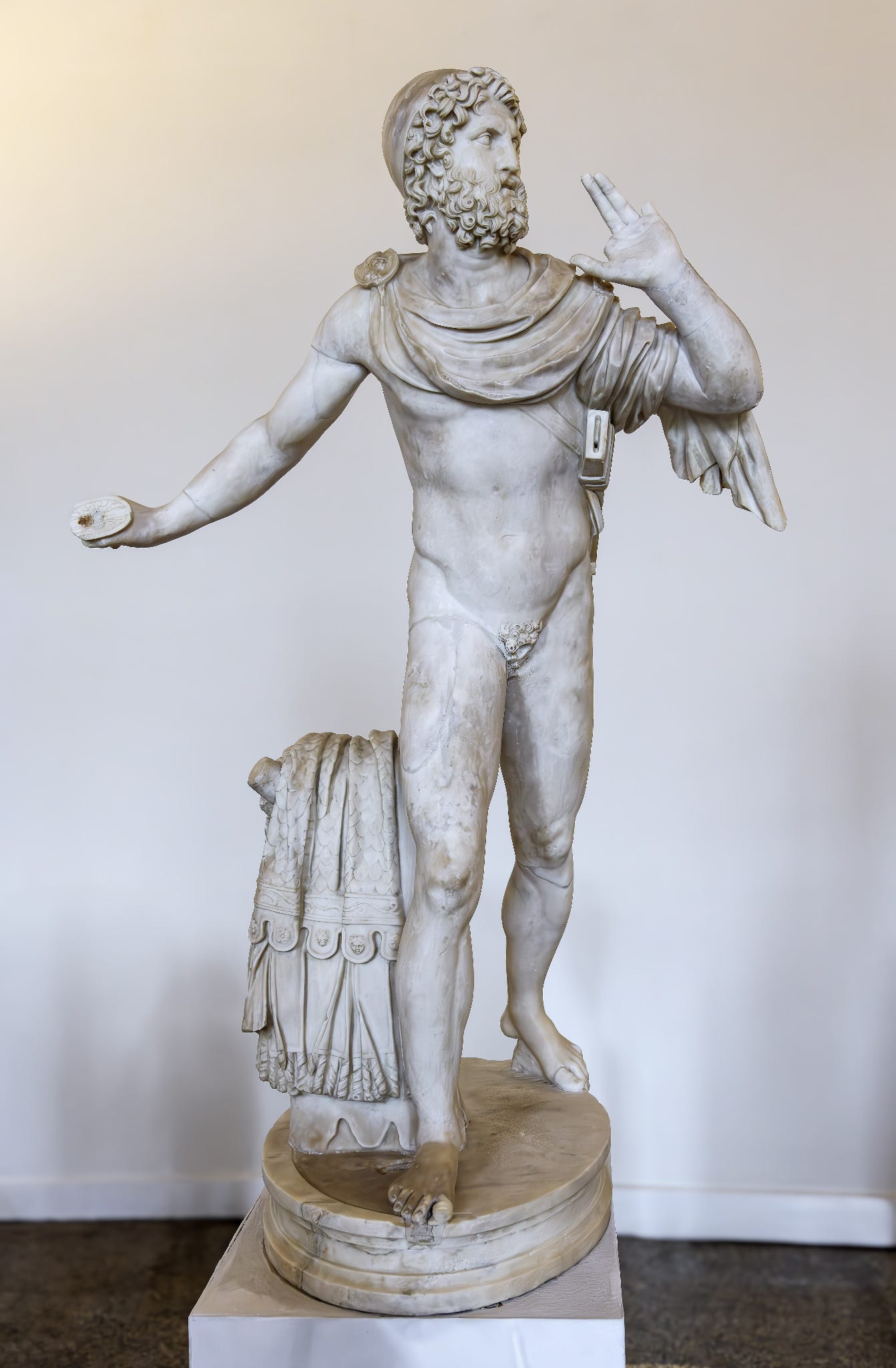
Source: Odysseus, Roman-imperial copy of an original from the Pergamon school dated between the end of the 3rd and the middle of the 2nd century BC. Sixteenth-century restorations by Tiziano Aspetti. Coming from Rome, Public Domain
Tell me, Muse, of the man of many ways, who was driven far journeys, after he had sacked Troy’s sacred citadel. Many were they whose cities he saw, whose minds he learned of, many the pains he suffered in his spirit on the wide sea, struggling for his own life and the homecoming of his companions. Even so he could not save his companions, hard though he strove to; they were destroyed by their own wild recklessness, fools, who devoured the oxen of Helios, the Sun God, and he took away the day of their homecoming. From some point here, goddess, daughter of Zeus, speak, and begin our story.
- The Odyssey, Lattimore translation Book 1, 1-10.
The Iliad is the epic of anger, honor, glory, and war. The Odyssey is the epic of endurance, intelligence, temptation, homecoming, and restoration.
Achilles asks whether a short life filled with glory is preferable to a long and obscure life. Odysseus faces a different question:
Can a man endure everything the world can throw at him and still remain himself?
Welcome to Plato’s Workout
Plato’s Workout is a weekly meditation on the philosophy of human excellence.
Each week, you’ll find:
I. The Weekly Essay
Lessons in virtue, leadership, and life inspired by the great books of the Western tradition.
II. The Wisdom Practice
Aphorisms, maxims, and passages to reflect on and carry into your week.
III. Classics for the Digital Age
A curated selection of classical insights, quotations, and reflections discovered in today’s online conversations and brought together for thoughtful reflection.
Read deeply. Train wisely. Live virtuously.
The major cultural event of the summer of 2026 is Christopher Nolan’s movie adaptation of The Odyssey. In honor of the significant cultural influence and impact the movie is having, I’m launching a series of weekly lessons of human excellence (aka virtue), inspired by Homer’s second classic.
Let’s kick it off by reflecting on The Odyssey’s meta-theme: the return of the enduring hero.
Odysseus is not the strongest warrior. He is not the fastest runner, the most handsome prince, or the most imposing king. His gifts are different: intelligence, adaptability, patience, self-command, deception, courage, and an almost inexhaustible capacity to endure.
He is a hero of return.
But the return journey is not simple. Odysseus must survive monsters, storms, shipwrecks, temptations, divine hostility, the loss of every companion, and the danger of forgetting who he is. He must also return to a household that has been invaded by men who consume his wealth, dishonor his wife, and treat his kingdom as if it were ownerless.
The Odyssey is therefore not only about travel. It is about the recovery of identity, household, authority, and order.
Why read this book? — The Epic of Homecoming
The Odyssey is one of the foundational stories of Western civilization. It is the great archetype of the return journey: the soldier returning from war, the exile returning to his country, the adult returning to his family, and the soul seeking its true home.
The Greek word nostos means homecoming. It gives us the modern word “nostalgia,” but Homer’s nostos is more demanding than sentimental longing for the past. Odysseus does not merely remember Ithaca. He must earn his way back to it.
The journey tests whether he is worthy of returning.
The Odyssey also introduces a different type of heroism from the one we encounter in Achilles. Achilles is the supreme warrior: direct, brilliant, and terrifying. Odysseus is the hero of metis—cunning intelligence, practical wisdom, and resourcefulness.
He survives by adjusting himself to reality.
Sometimes he speaks openly. Sometimes he disguises himself. Sometimes he fights. Sometimes he waits. Sometimes he lies. Sometimes he allows others to underestimate him. His virtue is not always obvious because it is not always beautiful. Odysseus teaches us that leadership may require not only courage, but concealment; not only strength, but patience; not only honesty, but the intelligence to know when the truth cannot yet be safely spoken.
Yet Homer does not present Odysseus as morally perfect. His cleverness can become arrogance. His curiosity can become reckless. His desire to be recognized can endanger his men. Like Achilles, Odysseus is a flawed, mortal hero.
The Iliad teaches us that uncontrolled anger can destroy a man’s honor.
The Odyssey teaches us that uncontrolled desire—for knowledge, recognition, pleasure, or adventure—can delay a man’s return to what matters most.
Everyone, from the beginning, has learned from Homer. — Xenophanes
The Odyssey was not simply an entertaining adventure story for the ancient Greeks. It was a source of moral education. It taught young men how to become leaders, husbands, fathers, citizens, and rulers.
II. The Wisdom Practice
A strong and great soul is altogether distinguished by two features.
One is the contempt for the external things of this world. The great soul is persuaded that no man ought to wonder at, hope for, or seek after anything except those things related to goodness and virtue, and that he should succumb to neither another man, nor a disturbance of the spirit, nor a trial of Fortune.
The second feature is that, when you have molded your soul with this sort of attitude, as I said above, you perform great achievements of the highest utility which are extremely arduous, laborious, and full of danger to life and to many other things related to one’s livelihood.
- Cicero, On Duties
Roman statesman and Stoic-influenced philosopher Cicero, writing in On Duties, defines greatness of soul as freedom from the tyranny of externals joined to courageous service. The great souled man neither worships wealth, status, comfort, nor fears Fortune’s reversals; his allegiance is to goodness and virtue.
Yet detachment is not withdrawal. Having mastered his passions, he accepts difficult, useful work—even when it costs him. For our own formation, Cicero offers a demanding standard: train the soul to prize what cannot be taken away, then spend that strength in faithful action for the common good.
III. Classics for the Digital Age
The “Sexy” Odyssey Expectations vs. Reality

A viral post humorously pointing out the disconnect between modern expectations of “freaky” Ancient Greeks and the actual content of Homer’s Odyssey. It highlights how pop culture perceptions often clash with the grounded, epic nature of the source material.
Archaeologists Discover Odysseus Cult on Ithaca


A widely shared post about archaeological evidence revealing that Odysseus was more than a literary figure for ancient Greeks—he was the center of a religious cult on Ithaca that lasted for centuries.
My take: A thousand years of worship on Ithaca! It suggests the Odyssey wasn’t just a poem, but a blueprint for the survival of the spirit that people actually honored.
15 Ancient Rules for Modern Life

A curated digest of practical wisdom from Stoicisim and the Great Books, focusing on rules like “Amor Fati,” “Die Before You Die,” and the “Art of Sitting Still” to help modern professionals navigate life.
My take: The focus on ‘Taming Attention’ as the primary skill of character is spot on. Philosophy is essentially the training of attention toward the Good