

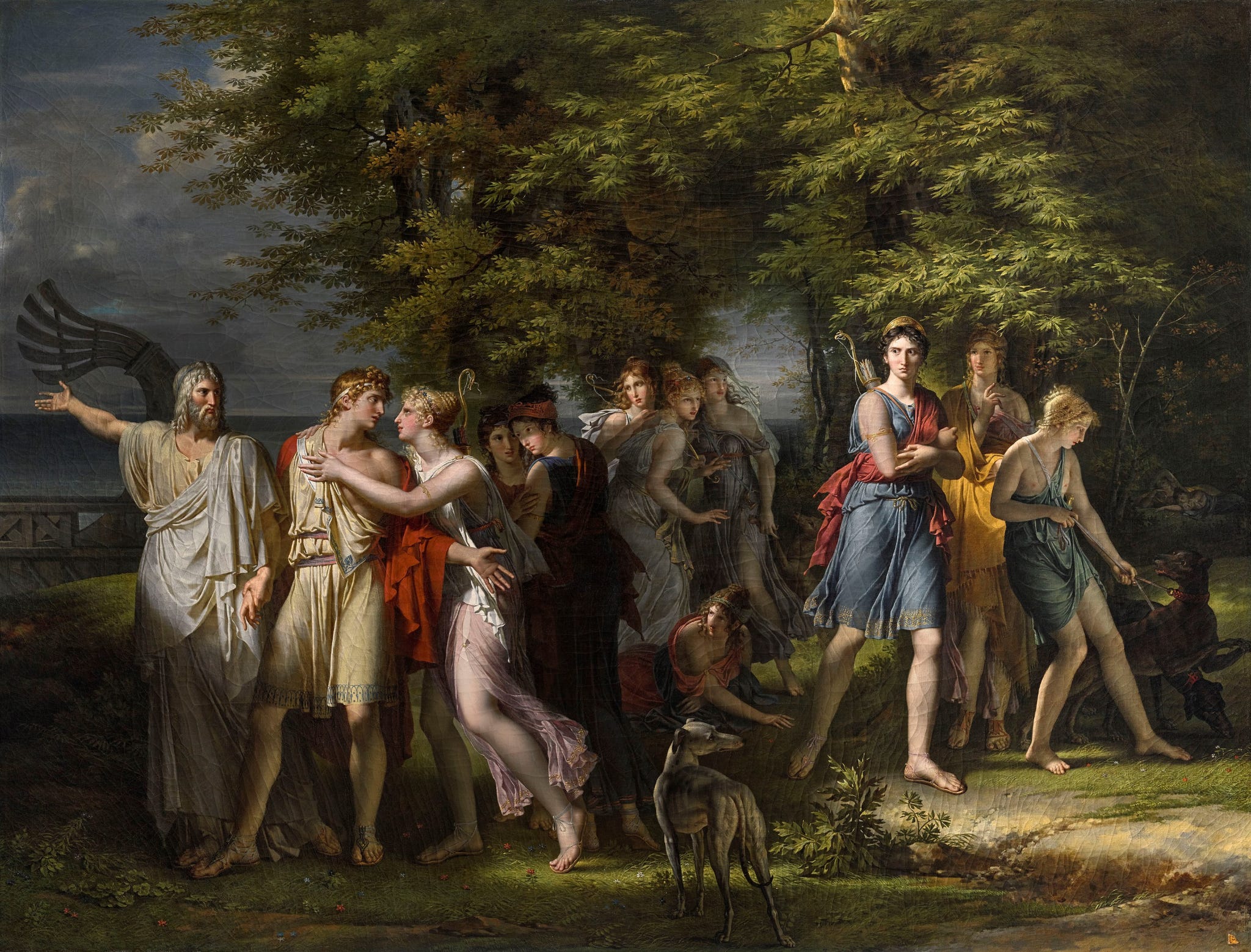
Source: Charles Meynier, Telemachus, Urged by Mentor, Leaving the Island of Calypso. Public Domain.
But for yourself, I will counsel you shrewdly, and hope you will listen. Fit out a ship with twenty oars, the best you can come by, and go out to ask about your father who is so long absent, on the chance some mortal man can tell you, who has listened to Rumor sent by Zeus. She more than others spreads news among people.
….
Then, after you have made an end of these matters, and done them, next you must consider well in your heart and spirit some means by which you can kill the suitors who are in your household, by treachery or open attack. You should not go on clinging to your childhood. You are no longer of an age to do that.
- Athena, as Mentes, counseling Telemachus - Book 1, 279-283 & 293-297, Latimore translation
The Odyssey begins not with Odysseus, but with his absence.
He is trapped far from Ithaca, while his household is being consumed by the suitors. His son, Telemachus, is still young and uncertain. His wife, Penelope, is surrounded by men who assume that Odysseus will never return.
The household has lost its visible ruler.
But Ithaca has not been completely abandoned. Athena remains concerned with Odysseus and his family. She sees the disorder in the house and recognizes that Telemachus cannot become a leader by remaining passive.
In the opening books of The Odyssey (often called the Telemachy), Homer provides one of literature’s most enduring blueprints for guidance, maturation, and personal agency.
The young man needs a mentor.
Welcome to Plato’s Workout
Plato’s Workout is a weekly meditation on the philosophy of human excellence.
This week, you’ll find:
I. The Weekly Essay - Athena as the first mentor
Lessons in virtue, leadership, and life inspired from the great books of the Western tradition.
II. The Wisdom Practice - Thoreau on forging character
Aphorisms, maxims, and passages to reflect on and carry into your week.
III. Classics for the Digital Age - Western Civilization courses back in military schools
A curated selection of classical insights, quotations, and reflections discovered in today’s online conversations and brought together for thoughtful reflection.
Read deeply. Train wisely. Live virtuously.
Athena does not simply solve the problem for Telemachus. She does something more valuable: she awakens him to the necessity of action. Disguised first as Mentes, then later as Mentor she visits Ithaca and challenges and helps Odysseus son him to stop behaving like a child in his own house.
She asks him to investigate his father’s fate, call an assembly, confront the suitors, and travel in search of news.
This is the beginning of Telemachus’ formation.
When Telemachus prays to Athena for guidance she appears to him as Mentor He is an elder Ithacan nobleman and trusted household friend whom Odysseus left in charge of his domestic affairs when departing for Troy.
Mentor not only encourages young Telemachus, instilling courage and resolve in the young prince …
So he spoke in prayer, and from nearby Athene came to him likening herself to Mentor in voice and appearance. Now she spoke aloud to him and addressed him in winged words: ‘Telemachos, you are to be no thoughtless man, no coward, if truly the strong force of your father is instilled in you; such a man he was for accomplishing word and action. Your journey then will be no vain thing nor go unaccomplished. But if you are not the seed begotten of him and Penelope, I have no hope that you will accomplish all that you strive for.
- Athena, as Mentor, inspiring Telemachus - Book 2, 267-275 Latimore translation
….But he also help him plan his departure and organize his journey;
And that journey for which you are so urgent will not be long now, such a companion am I to you, as of your father. I will fit you out a fast ship, I myself will go with you. But now you must go back to the house, and join the suitors, and get ready provisions for the journey, pack all in containers, have wine in handled jars, and barley meal, men’s marrow, in thick leather bags, and I, going round the town, will assemble volunteer companions to go with you.
-Athena, as Mentor, planning for Telemachus -Book 2, 285-292 Latimore translation
Our lesson: A mentor does not merely provide answers. A mentor reveals the task that a young person must undertake for himself.
Telemachus already possesses a royal identity by birth. But he does not yet possess royal authority. He is the son of Odysseus, but he has not yet become Telemachus.
Athena helps him move from inheritance to responsibility.
A leader often begins in this uncertain condition. He may possess the title, the family name, the education, or the opportunity. But authority cannot be inherited in full. It must be embodied.
Athena teaches Telemachus several lessons:
Do not accept disorder as normal.
Do not confuse youth with permanent helplessness.
Seek information before making decisions.
Call others to account publicly.
Leave the safety of the household to learn how the world works.
Return with greater knowledge and greater authority.
Athena is not a mentor who makes Telemachus dependent on her. She gives him confidence, but she also gives him a mission.
Every ambitious person needs an Athena: a guide who sees our potential before we do, but who also refuses to let us remain comfortable.
II. The Wisdom Practice
“You cannot dream yourself into a character; you must hammer and forge yourself into one.” - Henry David Thoreau
In his private journals, 19th-century American essayist and philosopher Henry David Thoreau noted: “You cannot dream yourself into a character; you must hammer and forge yourself into one.”
Thoreau cuts straight through modern romantic delusions of passive transformation, invoking the ancient imagery of the blacksmith’s anvil. Virtue (arete) is never an innate gift or a product of mere positive visualization, but the deliberate outcome of intense friction, heat, and disciplined labor.
For the traditional leader seeking genuine human excellence, this truth is foundational: your moral and physical character is not discovered in comfort, but forged through daily trials, rigorous spiritual discipline, and uncompromising self-mastery.
III. Classics for the Digital Age
Great Books of the West - Independent Study Movement

Government education has (deliberately) failed to teach the Great Books of the West for decades. A viral post highlighting the perceived failure of the government education system to teach the “Great Books” and promoting an independent group dedicated to studying the Western canon to “form the mind.”
My take: Independent study groups are where the true ‘Gymnasium’ of the mind is moving. The ‘Great Books’ aren’t just historical artifacts; they are the curriculum for a free mind.
Western Civilization in Military Schools

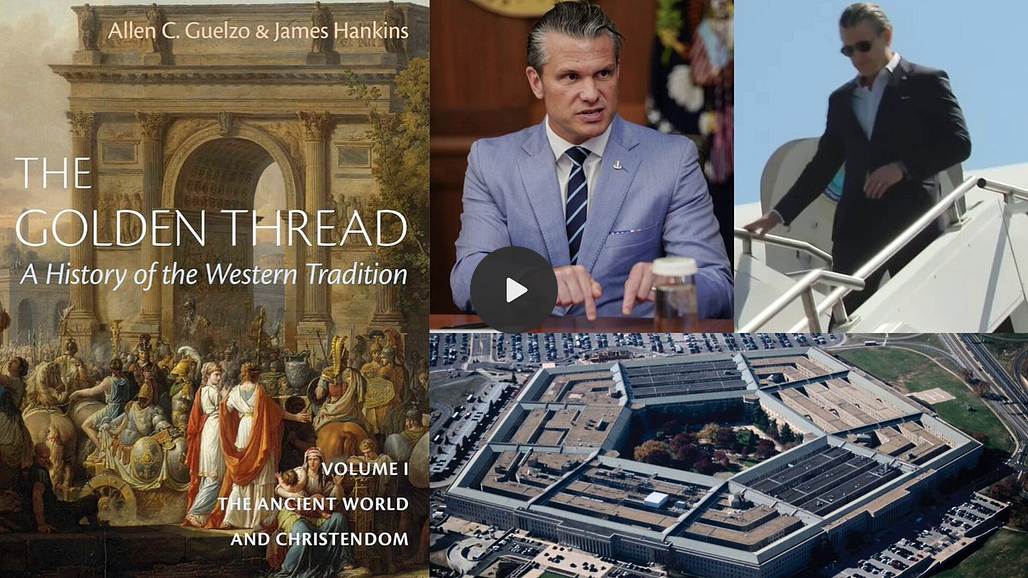
A report on the Department of Defense Education Activity (DoDEA) introducing a new high school course “Western Civilization to 1500,” prompting intense debate over the role of classical learning and Christianity in education.
My take: As a product of US military schools I applaud this decision. The study of Western Civ provides the ‘grammar’ of our modern world. Regardless of the political lens, understanding these roots is essential for critical thinking. Focusing on ‘The Golden Thread’ is a bold move. It would be fascinating to see them include Plutarch’s ‘Parallel Lives’ to show how character (ethos) shaped these civilizations.