

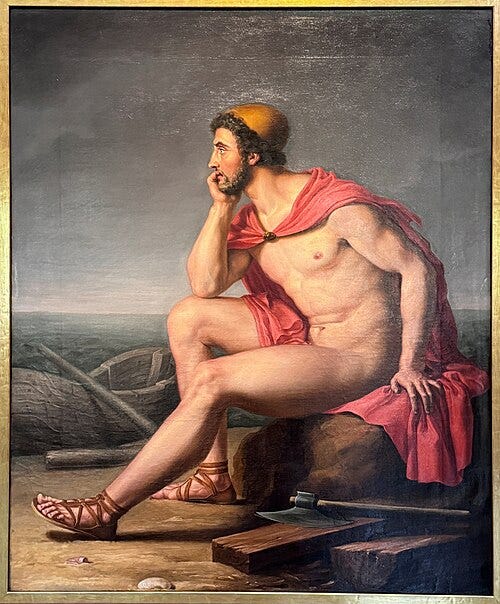
Source: Johann Heinrich Beck, Odysseus sitting on the shore of Calypso’s island, ca.1820. Public Domain
‘Noble son of Laertes, if you truly wish to go home
to your own dear country now, well then, go.
But if you only knew what grief fate holds in store for you
before you reach your home, you would stay here with me
and be immortal, however much you long to see that wife of yours,
whom you pine for every day.
And yet I think I am not inferior to her in face or figure,
since it is not likely that mortal women could rival immortal goddesses
in beauty and in grace.’ — Book 5, 149–158
The governing arc of the Odyssey is nostos: homecoming. But nostos is not merely geographical — not simply the act of sailing back to Ithaca. It is moral, political, domestic, and spiritual. To return home is to recover one’s proper place, duties, affections, and order after a long and costly estrangement.
And the Odyssey’s first great moral test is whether Odysseus can resist the substitutes — the false homecomings — that are offered in place of the real one.
Welcome to Plato’s Workout
Plato’s Workout is a weekly meditation on the philosophy of human excellence.
This week, you’ll find:
I. The Weekly Essay - Nostos and the Discipline of Return
Lessons in virtue, leadership, and life inspired from the great books of the Western tradition.
II. The Wisdom Practice - James A. Michener on Excellence as a way of life.
Aphorisms, maxims, and passages to reflect on and carry into your week.
III. Classics for the Digital Age - Plato as a wrestler, going viral on TikTok
A curated selection of classical insights, quotations, and reflections discovered in today’s online conversations and brought together for thoughtful reflection.
Read deeply. Train wisely. Live virtuously.
The most seductive of these counterfeits is Calypso. She is not merely beautiful; she is immortal, and she offers him what no mortal woman can — agelessness itself.
It is a remarkable offer. Immortality. Agelessness. A divine partner more beautiful than any mortal woman.
She is not wrong that the way home will be brutal. And Odysseus knows it. His reply is one of the moral pinnacles of the epic:
Then resourceful Odysseus answered her:
‘Goddess, do not be angry with me for this.
I know very well that compared to you,
Penelope is inferior in stature and in beauty,
for she is mortal while you are immortal and ageless.
Yet even so, I long and yearn every day to reach home
and to see the day of my return.
And if some god should wreck me on the wine-dark sea,
I shall endure it, with an enduring heart —
for I have a mind that is used to suffering.
I have already suffered much, and labored much,
in the waves and in the wars. Let this be added to that.‘
— Book 5, 215–224
Our lesson: A hero must know what home is — or he will trade it away without realizing it. Many things in life imitate fulfillment: pleasure, comfort, prestige, flattery, even exalted alternatives like immortality itself. But if they detach a man from his rightful duties and affections, they are not fulfillment. They are Calypso’s cave. They are Circe’s wine. The discipline of return requires knowing, every day, what you are returning to — and choosing it with full awareness of its costs.
II. The Wisdom Practice
The master in the art of living makes little distinction between his work and his play, his labor and his leisure, his mind and his body, his information and his recreation, his love and his religion. He hardly knows which is which. He simply pursues his vision of excellence at whatever he does, leaving others to decide whether he is working or playing. To him he’s always doing both. - James A. Michener
In his 1974 essay on education, Excellence, Pulitzer Prize-winning novelist James A. Michener offers a timeless definition of unified character that directly echoes the Greek ideal of arete (complete human excellence).
Rather than compartmentalizing existence into the false modern dichotomy of “work-life balance,” the true master cultivates an integrated soul where every vocation, physical discipline, and intellectual pursuit serves a single, higher calling.
For our own flourishing, Michener reminds us that excellence is not an isolated task we perform, but a continuous way of being. When virtue guides your aim, duty becomes devotion, labor transforms into joyful mastery, and every daily act draws you closer to living as a complete, unified leader.
III. Classics for the Digital Age
“Truly honouring the spirit of the Ancient Greeks”


A viral post tapping into the current aesthetic and cultural resurgence of Ancient Greek imagery, likely a visual meme or high-quality sculptural edit that frames modern sensibilities through a classical lens.
My take: Capturing the Kalos Kagathos (the beautiful and the good) for the modern age. It’s fascinating how these forms still dictate our sense of aesthetic perfection 2,500 years later.
Plato as a Wrestler, going viral on TikTok (Nicknames and Narratives)
https://www.tiktok.com/discover/plato-if-you-disagreed-with-him
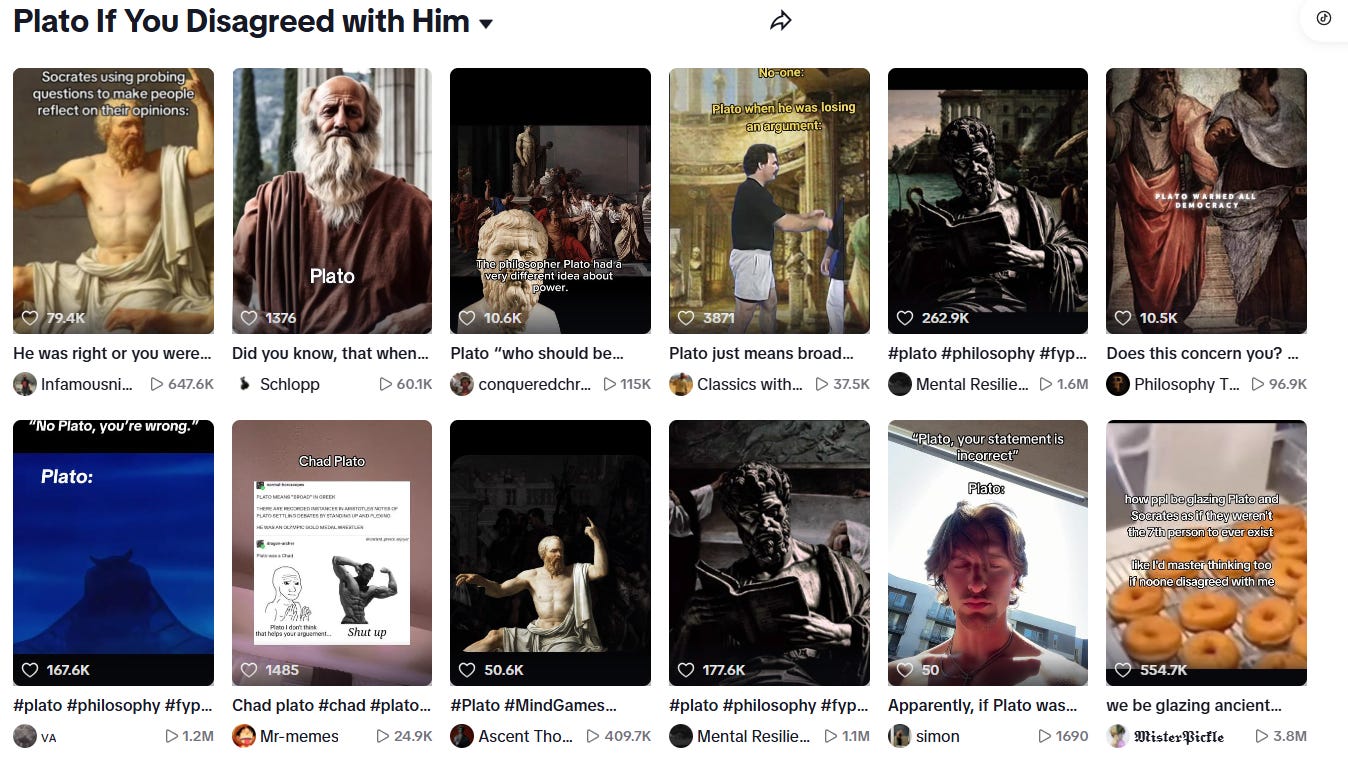
Viral content on TikTok highlighting the fact that Plato was an Olympic-level wrestler whose name (Plateus) likely meant “Broad” in reference to his physique, adding a human/physical dimension to the philosopher.
My take: People forget that the Academy had an outdoor gym. For the Greeks, a sharp mind required a strong body—modern philosophy could use a bit more ‘Plateus’.
Socrates and Aristotle Eating Gyros
https://www.tiktok.com/discover/socrates-and-aristotle
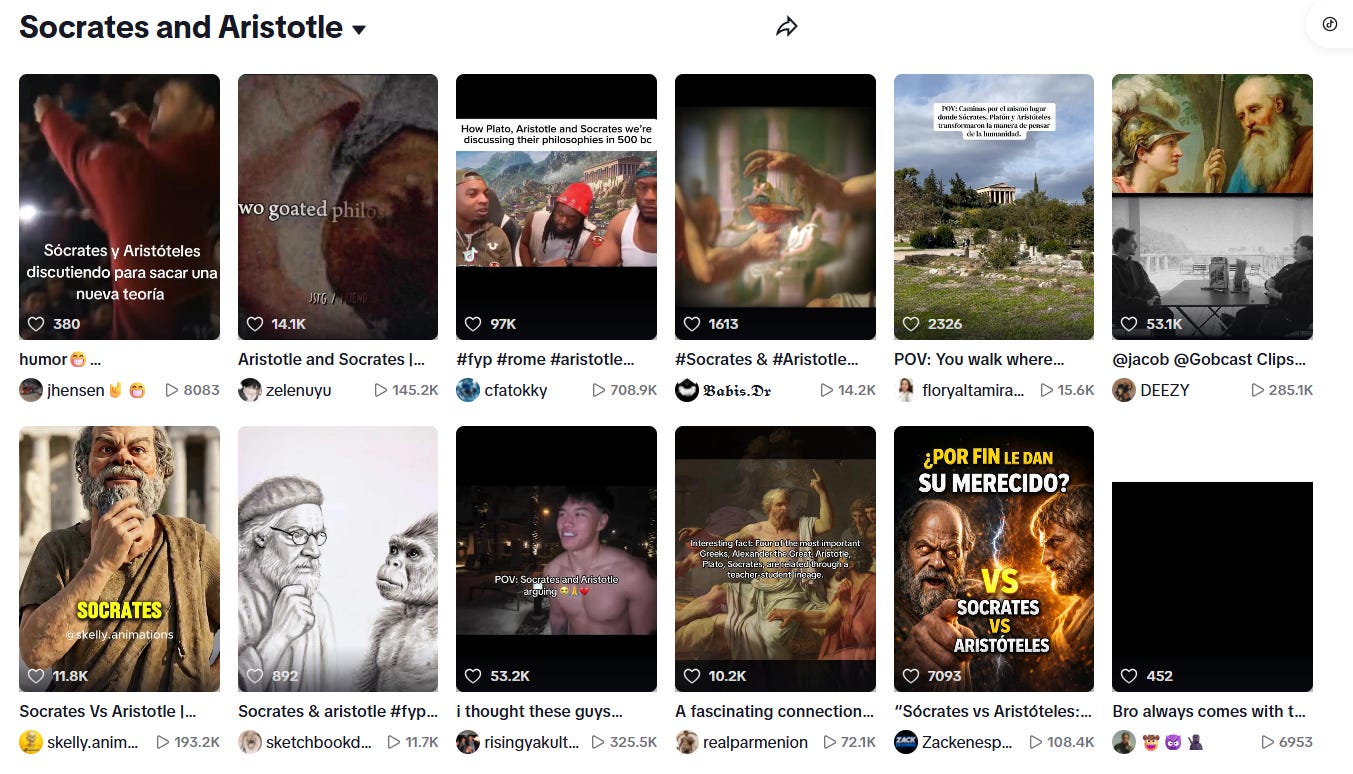
Humorous anachronistic sketches placing Greek philosophers in modern Athens settings, using wit to make classical figures relatable to a Gen Z audience.
My take: Socrates would definitely be the guy asking the gyro shop owner 50 questions about the true ‘nature’ of a pita until he got kicked out.